
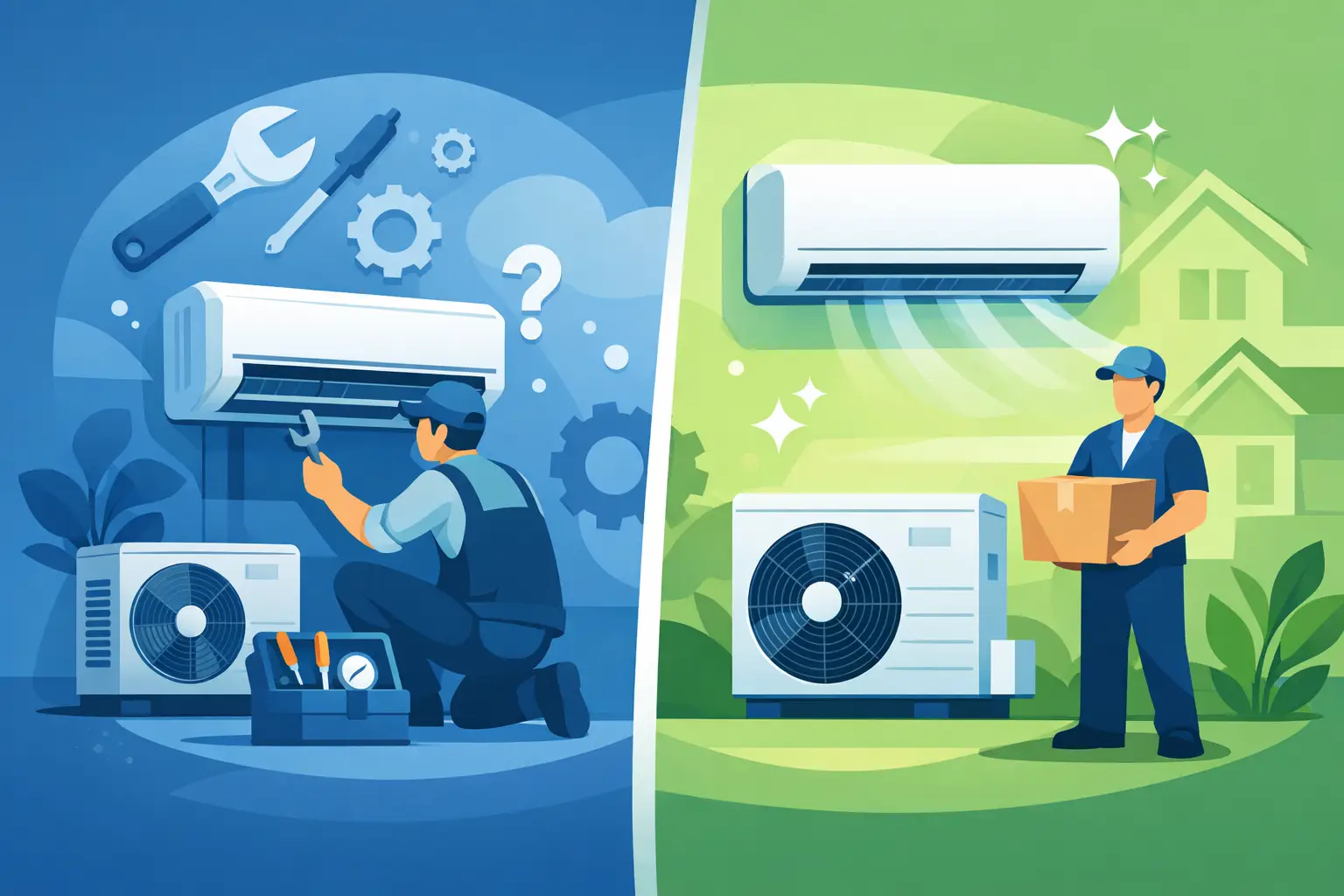
When your system starts blowing warm air on a 95-degree day, the question gets urgent fast – should you repair or replace air conditioner equipment that is already giving you trouble? For homeowners and business owners, the right answer usually comes down to a mix of age, repair history, energy use, and whether the system still suits the space it serves.
A quick fix is sometimes the smart choice. In other cases, putting more money into an older unit only delays a bigger and more expensive problem. The goal is not to push every customer toward replacement. It is to make a clear decision based on reliability, comfort, and long-term cost.
How to decide whether to repair or replace air conditioner systems
The first thing to look at is the nature of the fault. Some issues are relatively minor: a failed capacitor, a clogged drain line, a faulty thermostat, or a worn contactor. These repairs are often worthwhile if the rest of the system is in good shape. If the unit has generally been reliable and the repair cost is reasonable, fixing it can make sense.
The conversation changes when the problem points to broader wear. A failing compressor, evaporator coil leak, recurring refrigerant loss, or repeated electrical faults often suggest the system is nearing the end of its useful life. If major components are starting to fail one after another, replacement is usually the more practical investment.
Age matters as well. Most air conditioning systems can last well over a decade with proper maintenance, but performance tends to decline over time. If your unit is over 10 to 15 years old and needs a major repair, it is worth comparing that cost against the benefits of a newer, more efficient system.
The biggest factors that affect the decision
Repair cost versus replacement value
A common rule of thumb is to compare the repair bill to the value of the system and its remaining life. Spending a small amount to restore a relatively young unit is one thing. Spending a large amount on an older system with uncertain reliability is another.
For example, if a repair is minor and your system is only six years old, replacement is usually hard to justify. But if the quote involves a major component and the unit is already past its prime, that same money may be better put toward a new installation with a fresh warranty and lower operating costs.
System age and expected lifespan
Age by itself does not automatically mean replacement. Some systems have been well installed, well maintained, and still perform reliably after many years. Others start declining much earlier because of heavy use, poor maintenance, or being undersized or oversized from day one.
That said, once a system enters the later stage of its life, repair decisions need to be more conservative. Even if you fix one issue, another may not be far behind.
Energy efficiency and utility bills
Older air conditioners often use more electricity to deliver less comfort. You may notice longer run times, uneven cooling, or monthly bills that keep climbing without any major change in usage. This is where replacement can make a measurable difference.
A modern high-efficiency system is not just about lower energy use. It can also provide better humidity control, quieter operation, stronger airflow, and more consistent temperature across the space. For commercial sites, those gains can matter just as much as the energy savings.
Frequency of breakdowns
One isolated repair is not usually a reason to replace a system. Repeated service calls are different. If the air conditioner has become unpredictable during peak summer conditions, reliability becomes a serious concern.
For a household, that means discomfort and disruption. For a business, it can affect staff, customers, equipment, or trading conditions. At a certain point, the hidden cost of ongoing breakdowns becomes just as important as the repair bill itself.
Refrigerant type and parts availability
If an older system uses outdated refrigerant or has hard-to-source parts, repair may become less practical. Even if the immediate issue can be fixed, future service could become more expensive and less certain. In those cases, replacing the unit may protect you from repeated delays and rising repair costs.
Signs repair is probably the right move
Repair is often the better option when the system is still within a reasonable age range, the issue is isolated, and the unit has not had a pattern of major faults. If it cools effectively, holds temperature well, and your energy bills have remained stable, there is a good chance a professional repair will restore normal performance.
It also makes sense to repair if the current system still matches the property well. A properly sized ducted or split system that meets your comfort needs can be worth keeping if the repair is straightforward.
Maintenance history counts here. A unit that has been serviced regularly tends to be a better candidate for repair than one that has been neglected for years.
Signs replacement may save you more in the long run
Replacement becomes the stronger option when comfort has declined across the board. Maybe some rooms never cool properly, the unit struggles in hot weather, airflow is weak, or noise has increased. These are not always single-component problems. Sometimes they reflect a system that is simply worn out or no longer suitable for the building.
It is also worth considering replacement if your needs have changed. Renovations, added rooms, changed floor plans, higher occupancy, or longer operating hours can all put more strain on an existing system. In that situation, repairing the old unit may solve the immediate fault without solving the bigger comfort problem.
For commercial clients, this comes up often when a retail space, office, or small warehouse is using equipment that no longer suits the load. A replacement may improve both reliability and operating efficiency at the same time.
Repair or replace air conditioner units in homes versus businesses
Residential and commercial decisions follow the same principles, but the stakes can be different. At home, the focus is usually on comfort, noise, budget, and power bills. In a business, downtime and consistency are often the bigger concerns.
A homeowner may tolerate one more repair if the unit can make it through the season. A business owner may decide that replacement is the better move simply because an unreliable system creates too much operational risk. Offices, shops, and client-facing spaces depend on stable indoor conditions.
The type of system matters too. A single wall-mounted split system is a different decision from an aging ducted setup or a larger VRV/VRF arrangement. Larger systems involve more components, more zones, and more variables, so the right path should be based on a proper inspection rather than guesswork.
Why a professional assessment matters
This is one area where clear advice makes a real difference. A good technician should not just quote a repair and leave it at that. They should explain what failed, whether the issue is isolated or part of a larger pattern, and what the likely outlook is over the next few years.
That includes checking airflow, refrigerant performance, electrical condition, coil health, drainage, and overall system suitability for the space. If replacement is being considered, sizing and design matter just as much as the equipment itself. An efficient unit that is poorly selected or poorly installed will not deliver the results you expect.
At Cool Air Tech, that practical approach is central to how recommendations are made. The right answer is the one that gives you dependable performance, fair value, and confidence heading into the next season.
The question to ask before you spend money
Before approving any work, ask a simple question: will this repair give me confidence in the system for the next few years, or am I paying to postpone replacement? That question usually cuts through the uncertainty.
If the fix is modest, the system is not too old, and performance has otherwise been solid, repair can be the right call. If the unit is aging, inefficient, and starting to fail in larger ways, replacement is often the more economical choice over time.
A trustworthy HVAC contractor should be able to show you both sides clearly. That way, you are not choosing based on pressure. You are choosing based on how the system performs, what it costs to keep, and how much reliability matters for your home or business.
The best decision is rarely about the cheapest option today. It is about whether your air conditioning will keep doing its job when you need it most.