
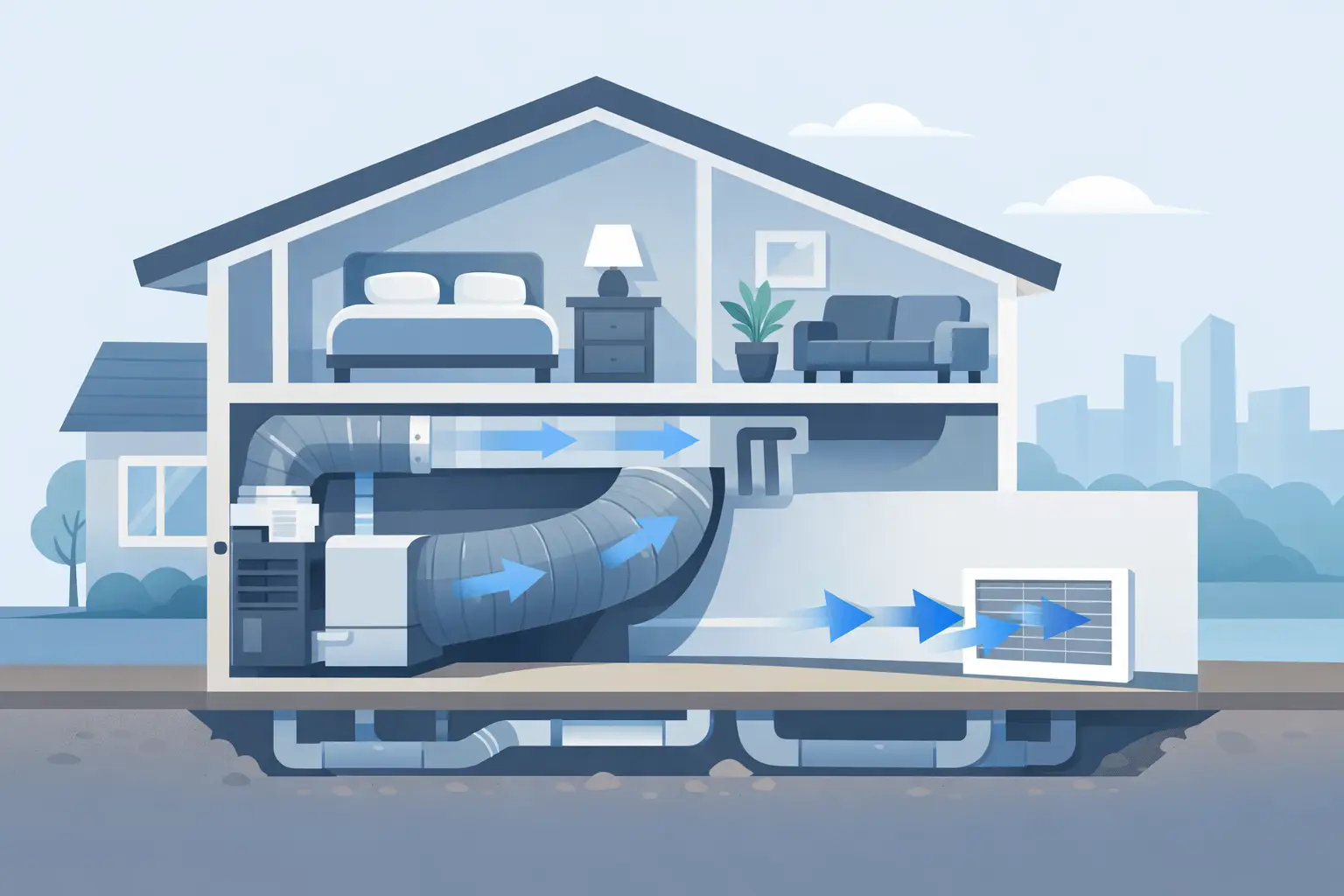
A ducted heating and cooling system can have an excellent outdoor unit, well-designed supply ducts, and efficient zoning, yet still perform poorly if it cannot pull air back to the system properly. This guide to ducted return air explains the often-overlooked side of HVAC design that affects comfort, noise, indoor air quality, and energy use every day.
Return air is not the air delivered into a room. It is the air drawn from the home or building, passed through a filter, and returned to the indoor unit to be heated or cooled again. The system needs both sides of that loop: supply air to condition the space and return air to keep the equipment moving the right volume of air.
What Ducted Return Air Does
A return-air grille is usually found in a central ceiling, hallway wall, or utility area. Behind it is a return duct that carries indoor air to the air handler or fan coil. After passing through the filter and across the indoor coil, the air is redistributed through supply vents.
This circulation process does more than maintain a set temperature. A correctly designed return path helps the system remove heat in cooling mode, distribute warm air in heating mode, and filter airborne dust before air is recirculated. It also allows the blower to operate at its intended airflow level.
When return airflow is restricted, the system has to work harder to move air. Rooms may cool or heat slowly, the blower can become noticeably louder, and operating costs may rise. In severe cases, restricted airflow can contribute to coil icing during cooling or equipment shutdowns caused by safety controls.
Return Air Is Different From Supply and Exhaust Air
The three terms are easy to confuse, but they serve very different purposes.
Supply air is the conditioned air pushed into rooms through ceiling, floor, or wall registers. Return air is drawn back through one or more return grilles to be conditioned again. Exhaust air is removed from the building altogether, typically through bathroom fans, range hoods, or commercial ventilation equipment.
A return grille should not be blocked because it is not simply a vent. It is an active intake for the HVAC system. Covering it with furniture, closing off the surrounding area, or allowing filter buildup to restrict it can reduce performance across the entire system.
Why Return-Air Design Affects Comfort
Many comfort complaints that seem like an air conditioner problem are actually airflow problems. A system may be correctly sized for the building, but a small return duct, poorly located grille, or neglected filter can prevent it from circulating enough air.
The result is often uneven temperatures. Bedrooms at the far end of the home may feel stuffy, while the hallway near the main return feels comfortable. In a business, staff may notice that offices cool unevenly, or that a retail area is comfortable only when internal doors remain open.
A well-designed return system helps balance pressure throughout the building. Each room receiving supply air needs a practical path for air to leave that room and find its way back to the return. If a bedroom door is closed tightly and there is no return pathway, the supplied air can pressurize the room. That pressure reduces airflow from the supply vent and can make the room less comfortable.
One Central Return or Multiple Returns?
A single central return can work well in a smaller, open-plan home where air can move freely from bedrooms and living spaces toward a hallway or central area. It can also keep installation costs and filter maintenance straightforward.
Larger homes, multi-story properties, and buildings with separated zones may benefit from multiple return grilles or dedicated returns for key areas. These designs can improve airflow balance, reduce pressure issues behind closed doors, and make the system more responsive across the property. The trade-off is greater installation complexity and more components to inspect and maintain.
There is no universal best layout. The right approach depends on the floor plan, duct routing, door positions, zoning arrangement, ceiling cavities, and the capacity of the equipment.
Guide to Ducted Return Air Placement
Return grilles are generally positioned in areas where air can circulate freely, rather than directly beside supply vents. A central hallway, open living area, or common corridor is often suitable because it can draw air from several rooms without creating drafts in an occupied space.
Placement should also consider sources of heat, moisture, and contaminants. Returns should not draw directly from bathrooms, kitchens, garages, or areas where fumes, grease, or chemical odors may be present. Those areas need purpose-built exhaust ventilation instead.
For homes with a central return, door undercuts may provide enough air path for some rooms, but not always. If closed doors create noticeable pressure differences, an HVAC professional may recommend transfer grilles, jump ducts, or additional return pathways. These solutions allow air to move without requiring bedroom doors to stay open.
Commercial spaces need similar planning. Offices with enclosed meeting rooms, treatment rooms, storage areas, or frequently closed doors can develop airflow imbalances if returns are only located in open common areas. A proper assessment should account for how the space is actually used, not just how it appears on a floor plan.
Sizing Matters More Than Grille Appearance
A return grille may look large, but the duct behind it could still be too small for the required airflow. Return ducts, grilles, filters, bends, and transitions all create resistance. The more resistance in the return path, the more difficult it is for the blower to move air efficiently.
HVAC contractors size return systems based on the equipment’s required airflow, duct length, layout, static pressure, and filtration setup. This is why replacing a grille with a decorative model or adding a denser filter without checking the system can create issues. The change may look minor, but it can alter the system’s resistance significantly.
Oversized returns are not automatically better either. They can take up valuable ceiling or wall space, add cost, and may introduce noise or design problems if installed poorly. The goal is a return path that supports the equipment’s design airflow quietly and consistently.
Choosing the Right Filter
The return-air filter protects the indoor equipment and captures particles before the air is recirculated. It is one of the simplest maintenance items in any ducted system, but it needs to suit both the household’s needs and the HVAC equipment.
A higher MERV rating generally captures smaller particles, which can be useful for homes concerned about dust, pollen, or pet dander. However, high-efficiency filters can also restrict airflow if the system was not designed for them. A filter that is too restrictive may increase static pressure, strain the blower, and reduce heating and cooling performance.
For most properties, the right filter is a balance between filtration and airflow. The filter must fit securely, be installed in the correct direction, and be checked regularly. A loose or damaged filter can allow dust to bypass the frame and build up on the indoor coil and blower components.
Maintenance That Protects Return Airflow
Regular maintenance is usually less expensive than correcting a major airflow issue after performance has declined. Homeowners should inspect the return grille and filter routinely, especially during periods of heavy heating or cooling use.
Keep the grille clear of furniture, curtains, stored items, and heavy dust buildup. Replace or clean filters according to the manufacturer’s guidance and more often if the property has pets, renovation dust, high occupancy, or nearby construction. Washable filters need to be fully dry before reinstallation.
A professional maintenance visit can check the return duct, blower wheel, coil condition, filter rack, and system static pressure. These inspections can identify restrictions that are not visible from the grille, such as collapsed flex duct, disconnected ductwork, undersized transitions, or debris inside the return path.
Signs Your Return Air May Need Attention
Arrange an HVAC inspection if you notice several of these issues at the same time:
- Some rooms are consistently warmer or cooler than the thermostat setting.
- Airflow from supply vents feels weak, especially after changing the filter.
- The system becomes louder when doors are closed.
- Filters become dirty unusually fast or seem to bow inward.
- The indoor coil freezes, the system cycles unexpectedly, or energy bills rise without a clear reason.
These symptoms do not always point to the return system alone. Refrigerant problems, thermostat faults, duct leaks, and equipment wear can cause similar issues. A proper diagnosis should look at the whole system rather than replacing parts based on a single symptom.
A ducted system should make a home or workplace comfortable without demanding constant attention. If airflow feels uneven, noisy, or restricted, the return side is a sensible place to start. A qualified HVAC professional can assess the layout, measure system performance, and recommend improvements that match the building, the equipment, and the way the space is used.