
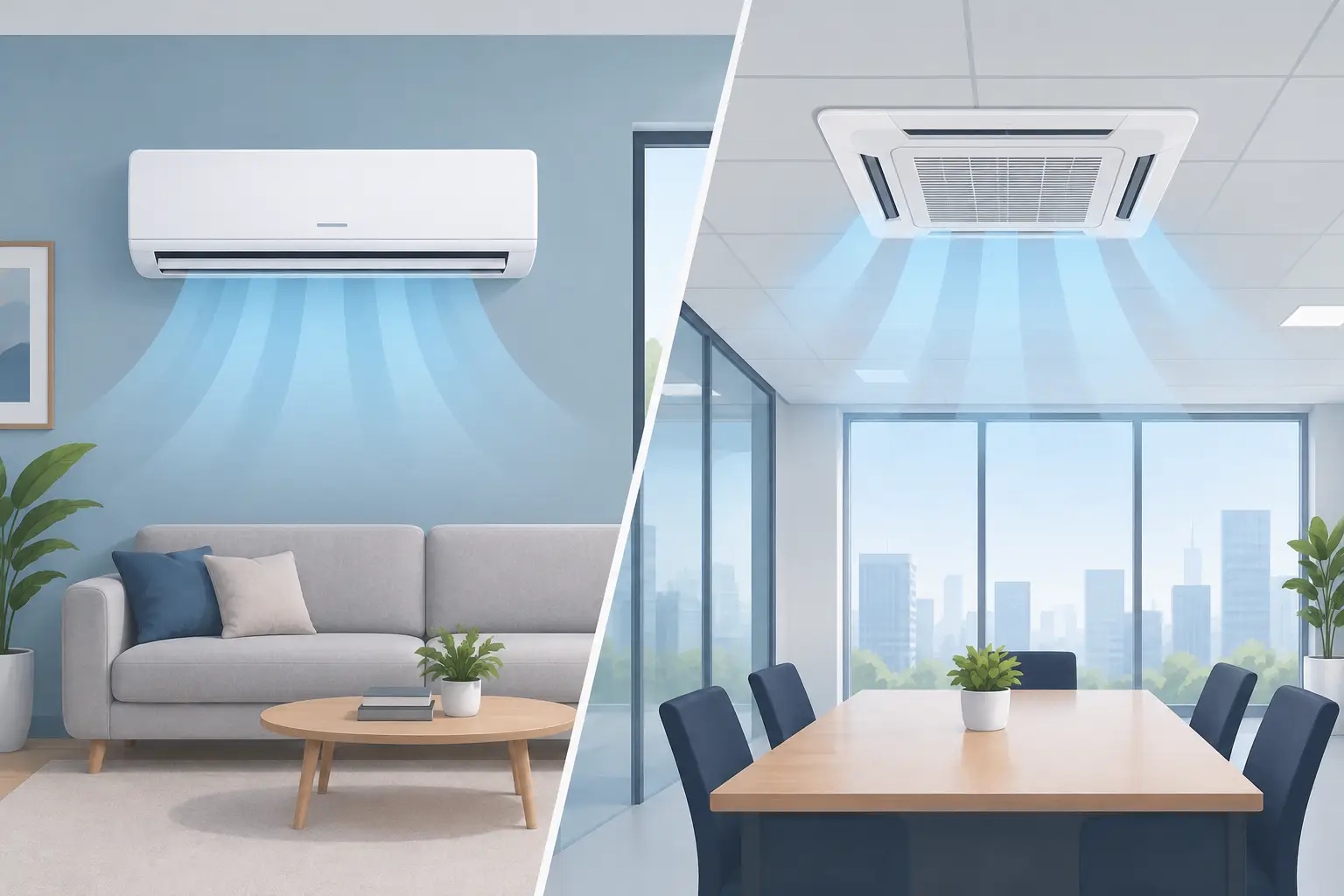
A wall versus cassette air conditioner decision often comes down to one practical question: where can the indoor unit go without compromising comfort, appearance, or the way the room is used? A wall-mounted system is usually the straightforward choice for a bedroom, apartment, or small office. A ceiling cassette can be the better fit for an open-plan area, shop floor, meeting room, or larger living space where even airflow matters.
Both options can provide efficient heating and cooling when they are correctly sized and professionally installed. The better system is not automatically the more expensive one. It is the one that suits the room layout, ceiling construction, occupancy, and how you expect to use the space every day.
Wall Versus Cassette: The Core Difference
A wall-mounted air conditioner, often called a high-wall split system, is installed high on an internal wall. It delivers conditioned air forward and downward across the room. It is common in bedrooms, smaller living rooms, apartments, individual offices, and rooms that need an affordable, independent comfort solution.
A cassette air conditioner sits within the ceiling, with its grille visible from below. Most cassette units distribute air in four directions, helping cover a larger area more evenly. They are commonly installed in suspended ceilings, but they can also work in some homes with adequate ceiling void space and access for drainage, refrigerant piping, wiring, and servicing.
The indoor unit design affects more than appearance. It changes air distribution, installation complexity, maintenance access, and the type of room where the system will perform best.
When a Wall-Mounted System Makes Sense
Wall-mounted units are popular because they are practical. Installation is generally less involved than installing a cassette, particularly when the indoor wall is close to the outdoor unit location. They are also available in a broad range of capacities, from compact bedroom units to larger models for open living areas.
For homeowners, a wall unit is often the right choice when one room is consistently too hot or too cold. A unit in a master bedroom can provide overnight comfort without conditioning the entire house. In an apartment, it can offer effective cooling where adding ductwork or altering ceilings is not realistic.
A wall-mounted system also makes sense for smaller commercial spaces. A private office, consultation room, back room, or compact retail tenancy may not need the coverage or ceiling integration of a cassette. The visible indoor unit is a trade-off, but modern wall units are slim, quiet, and unobtrusive when placed thoughtfully.
Airflow direction deserves attention. The unit needs a clear path to distribute air effectively. If it blows directly onto a desk, bed, sofa, or dining table, occupants may feel drafts even when the room temperature is correct. Placement and louver adjustment can solve many of these issues, but they should be considered before installation.
Where Ceiling Cassettes Perform Better
Cassette systems are designed for spaces where central airflow is more useful than air coming from one side of the room. A four-way cassette can distribute cooled or heated air across an open-plan office, retail floor, restaurant seating area, or large family room with fewer hot and cold spots.
Their biggest visual advantage is that most of the equipment is concealed above the ceiling. Only the face panel remains visible, which can provide a cleaner result in interiors where wall space is limited by windows, shelving, artwork, cabinetry, or display areas. For businesses, that can protect the look and function of the space.
Cassettes are often selected for commercial fit-outs because they work well with multi-split and VRF or VRV systems. A single outdoor system can support multiple indoor units, allowing different zones to be controlled independently. For example, a retail area may need stronger daytime cooling than a stockroom or private office.
However, a cassette is not simply a wall unit installed overhead. It requires enough ceiling space, safe structural support, a properly graded condensate drain, and service access. If the ceiling is solid concrete, too shallow, or difficult to access from above, installation can become expensive or impractical.
Airflow, Comfort, and Room Shape
Room dimensions often matter more than square footage alone. A long, narrow room may suit a wall unit positioned at one end, especially if there are no major obstructions. A nearly square, open room with people spread throughout it may benefit from the wider throw of a cassette.
Ceiling height changes the calculation as well. In a standard-height bedroom, a wall-mounted unit can direct air comfortably across the room. In a high-ceiling retail space or office, a cassette may need careful capacity selection and air-direction settings so conditioned air reaches occupants rather than collecting near the ceiling.
For either system, sizing should account for sun exposure, insulation, window area, heat-generating equipment, occupancy, and local climate. Oversizing can cause short cycling, where the system reaches set temperature too quickly without adequately managing humidity. Undersizing can leave the equipment running continuously on hot days while the room remains uncomfortable.
Cost and Installation Considerations
Wall-mounted split systems usually have a lower upfront cost because the indoor unit and installation requirements are simpler. The final price still depends on capacity, brand, line-set length, electrical upgrades, wall construction, outdoor-unit location, and whether a condensate pump is required.
A cassette system typically costs more to install. The contractor may need to open and reinstate ceiling sections, build support framing, run longer drainage lines, and coordinate access above the ceiling. In commercial properties, work may also need to be scheduled outside business hours or coordinated with other trades during a renovation.
That added investment can be justified when a cassette improves coverage, protects wall space, or creates a more polished finish. It may not be justified for a single small room where a wall system can provide the same comfort at a lower cost. Honest system design means recognizing that distinction rather than recommending the most complex option by default.
Maintenance Is Different, Not Optional
Both wall and cassette systems need regular filter cleaning, professional inspections, and prompt attention when performance changes. Dirty filters restrict airflow, increase running costs, and can contribute to water leaks or uneven temperatures.
Wall units are generally easier for occupants to access for basic filter cleaning. Cassette filters are accessed from below, but the larger ceiling-mounted assembly can require more careful cleaning of the grille, drain pan, condensate pump, and internal components. A blocked cassette drain can cause water damage to ceiling tiles, plaster, furnishings, or stock, so maintenance should not be delayed.
In a business setting, planned maintenance is particularly worthwhile. It helps identify drainage issues, worn electrical components, refrigerant concerns, and declining airflow before a breakdown affects staff or customers.
Choosing the Right System for Your Property
Start with the room, not the equipment. A wall-mounted system is often the sensible option for bedrooms, apartments, smaller offices, and individual rooms where budget and straightforward installation are priorities. A cassette is often more suitable for open rooms, commercial interiors, larger shared areas, and properties where wall space is at a premium.
Also consider your future plans. If you expect to add air conditioning to more rooms later, a multi-split, VRF, or ducted design may provide a better long-term path than selecting each unit independently. A site assessment can confirm whether the electrical supply, outdoor location, drainage route, and structure will support that plan.
Common Questions About Wall and Cassette Systems
Are cassette air conditioners quieter than wall units? Both can be very quiet when correctly selected and installed. Noise levels vary by model, fan speed, capacity, and installation quality. A cassette may feel less noticeable because the airflow is distributed from the ceiling rather than directed from one wall.
Can a cassette be installed in a house? Yes, provided there is adequate ceiling cavity depth, access, drainage, and structural support. They are especially useful in open-plan living spaces, renovations, and homes with suspended ceilings. A detailed inspection is needed before assuming a cassette will fit.
Which option is more energy efficient? Efficiency depends primarily on the unit’s rating, correct capacity, zoning, temperature settings, insulation, and maintenance. A well-sized wall unit can be highly efficient in a single room. A cassette can be efficient in a larger open area if its air distribution reduces temperature variation and unnecessary runtime.
Can one cassette cool several rooms? Not effectively if the rooms are enclosed. A cassette works best within one open zone. Separate rooms generally need separate indoor units, a ducted system, or a carefully designed multi-zone solution.
The best choice should feel intentional after installation: comfortable in every occupied area, quiet enough for the space, and practical to maintain for years. A qualified HVAC assessment can turn that goal into a system design that fits the building rather than forcing the building to fit the equipment.