
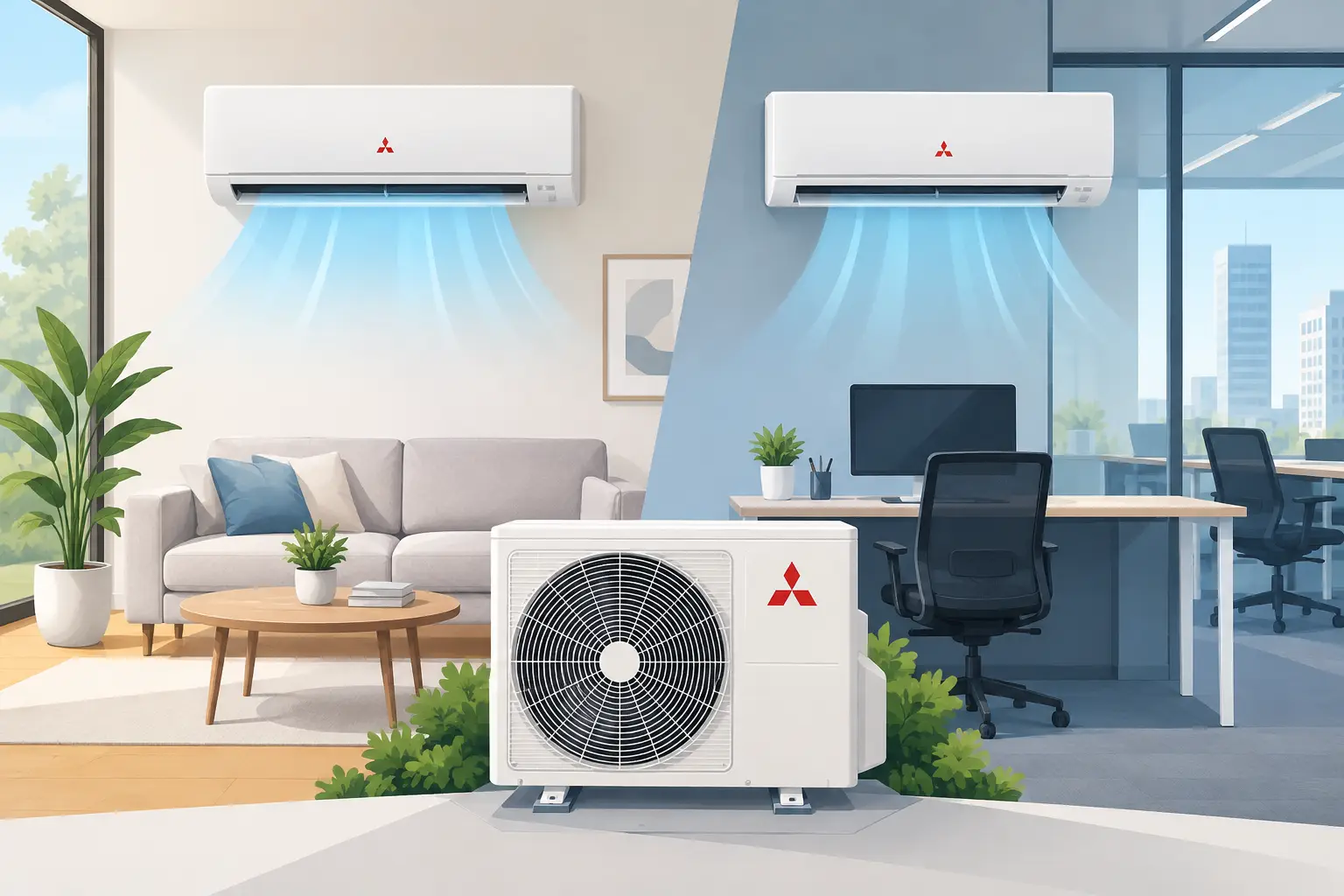
A Mitsubishi split system is rarely the cheapest option on an HVAC quote. That is also why a proper Mitsubishi split review needs to look beyond the upfront number. For homeowners and business owners, the real question is whether quieter operation, stronger efficiency, and dependable temperature control justify the investment over the life of the system.
Mitsubishi Electric split systems have built a strong reputation for inverter-driven heating and cooling, especially in rooms where ductwork is impractical or where one area needs independent control. They can be an excellent fit for bedrooms, living spaces, apartments, offices, retail areas, and small commercial zones. The right result, however, depends as much on sizing and installation quality as the name on the indoor unit.
Mitsubishi Split Review: The Short Answer
Mitsubishi splits are a strong choice for buyers who prioritize comfort, quiet performance, and efficient year-round operation. Their systems are generally well regarded for holding a steady set temperature rather than repeatedly switching fully on and off. That can make a noticeable difference in rooms that get hot afternoon sun, have large windows, or are used for long periods.
They are not automatically the best choice for every property. A basic single-room system from another reputable brand may suit a guest room or lightly used space at a lower initial cost. Larger homes may be better served by a ducted system or a multi-zone design rather than several separate wall-mounted units. The best system is the one designed around how the building is used, not simply the most premium model on the showroom floor.
What Mitsubishi Splits Do Well
Efficient temperature control
Most modern Mitsubishi split systems use inverter technology. Instead of running at full output until the room reaches temperature and then shutting down, the compressor can adjust its output to match demand. In practical terms, this often means more even comfort, less temperature swing, and reduced energy use compared with older fixed-speed equipment.
Efficiency still depends on the room and the installation. A system cooling a shaded, insulated bedroom will not face the same workload as one serving a west-facing living room with high ceilings and frequent door traffic. Selecting capacity from room size alone is a common mistake. Heat gain, insulation, glazing, occupancy, appliances, and ceiling height all matter.
Quiet operation for bedrooms and workspaces
Noise is one of the most common reasons people replace an older air conditioner. Mitsubishi indoor units are known for low sound levels at lower fan settings, which is useful in bedrooms, nurseries, meeting rooms, and home offices. Outdoor units are also generally designed for quieter operation than older equipment, although placement remains important.
A quiet system can still become disruptive if the outdoor unit is installed too close to a bedroom window, mounted on a resonant wall bracket, or placed where reflected sound is trapped between boundaries. Good equipment helps, but careful site planning is what protects everyday comfort.
Strong heating as well as cooling
A split system should not be viewed only as summer equipment. Reverse-cycle operation allows the same unit to provide heating in cooler months. For many homes and small commercial spaces, this can be a practical alternative to separate electric heaters, particularly when heating only occupied rooms rather than the entire building.
Performance in colder weather varies by model, installation conditions, and local climate. If reliable winter heating is a priority, it is worth comparing the heating capacity and efficiency figures, not just the cooling rating shown on the quote.
Flexible options for different spaces
Mitsubishi offers wall-mounted systems, ceiling cassettes, floor consoles, and concealed options depending on the market and application. Wall-mounted splits remain the most common choice because they are economical, effective, and relatively straightforward to install. They work particularly well when one room needs a dedicated solution.
For properties with several rooms, a multi-split system can connect multiple indoor units to one outdoor unit. This may improve exterior appearance where several condensers would be unwelcome. It is not always the lowest-cost path, though. Multi-split designs require careful capacity planning, and repairs to the shared outdoor unit can affect more than one room.
Where the Trade-Offs Matter
The main trade-off is cost. Mitsubishi systems often sit toward the premium end of the split-system market, particularly when comparing higher-efficiency models and advanced controls. Buyers should weigh that against expected run time. A frequently used family room, office, or main bedroom is more likely to benefit from efficiency and comfort features than a room used only a few weekends each year.
Appearance is another consideration. A wall-mounted indoor unit is visible, and drainage and refrigerant piping need a clean route to the outdoor unit. In renovated homes, apartments, or heritage-style properties, placement should be discussed early so the finished result is functional and visually considered.
No split system can solve every whole-home comfort issue. If rooms are far apart, if multiple levels have different temperature needs, or if you want discreet air outlets throughout the home, ducted air conditioning may be the better long-term option. Conversely, installing a ducted system solely to condition one or two rooms may add unnecessary cost and complexity.
Installation Quality Is Part of the Review
A Mitsubishi split can only perform as intended when it is installed correctly. The indoor unit needs suitable clearance for airflow and service access. The outdoor unit needs ventilation around it, a stable base or bracket, and a location that allows technicians to maintain it safely. Refrigerant pipework must be sized, insulated, pressure-tested, and evacuated properly before commissioning.
Drainage deserves equal attention. Poor condensate drainage can lead to water leaks, staining, odors, and mold concerns. Electrical supply requirements also need to be assessed before installation, especially in older homes or commercial tenancies with existing load demands.
Sizing is where professional advice has the greatest value. An undersized unit may run continuously on extreme days and struggle to reach the set temperature. An oversized unit can cool a small room too quickly, reduce dehumidification, and cycle inefficiently. A site assessment should account for the space itself rather than relying on a generic online calculator.
Maintenance and Expected Ownership Experience
Routine maintenance is straightforward but should not be skipped. Filters should be cleaned regularly, especially in homes with pets, high dust levels, or frequent system use. A blocked filter restricts airflow, reduces efficiency, and can make the system work harder than necessary.
Professional maintenance helps identify issues that homeowners cannot easily see, including coil buildup, drainage problems, refrigerant concerns, loose electrical connections, and declining performance. If a system starts blowing weakly, smells musty, leaks water, makes unusual noise, or takes much longer to cool the room, it is better to arrange service early than wait for a complete breakdown.
With correct installation and regular care, a quality split system can provide many years of dependable use. Warranty terms differ by model, installer requirements, and registration conditions, so confirm the applicable coverage before making a decision. Keep installation records and service documentation as part of responsible ownership.
Is a Mitsubishi Split Right for You?
A Mitsubishi split is worth serious consideration if you want efficient heating and cooling for a regularly used room, value lower operating noise, or need a reliable comfort upgrade without installing ductwork. It is especially suited to bedrooms, open-plan living areas, apartments, offices, and shops where individual zone control makes sense.
Before choosing a model, think about the room’s sun exposure, insulation, number of occupants, preferred indoor-unit location, outdoor-unit position, and how often you will use heating as well as cooling. For a multi-room property, compare separate splits, multi-split equipment, and ducted options on both installation cost and how you actually live or work in the space.
The most helpful next step is not choosing by brand alone. It is having the space assessed, the capacity calculated, and the installation planned around comfort, efficiency, and future service access. A well-designed system should feel quiet, consistent, and uncomplicated long after the first hot day has passed.