
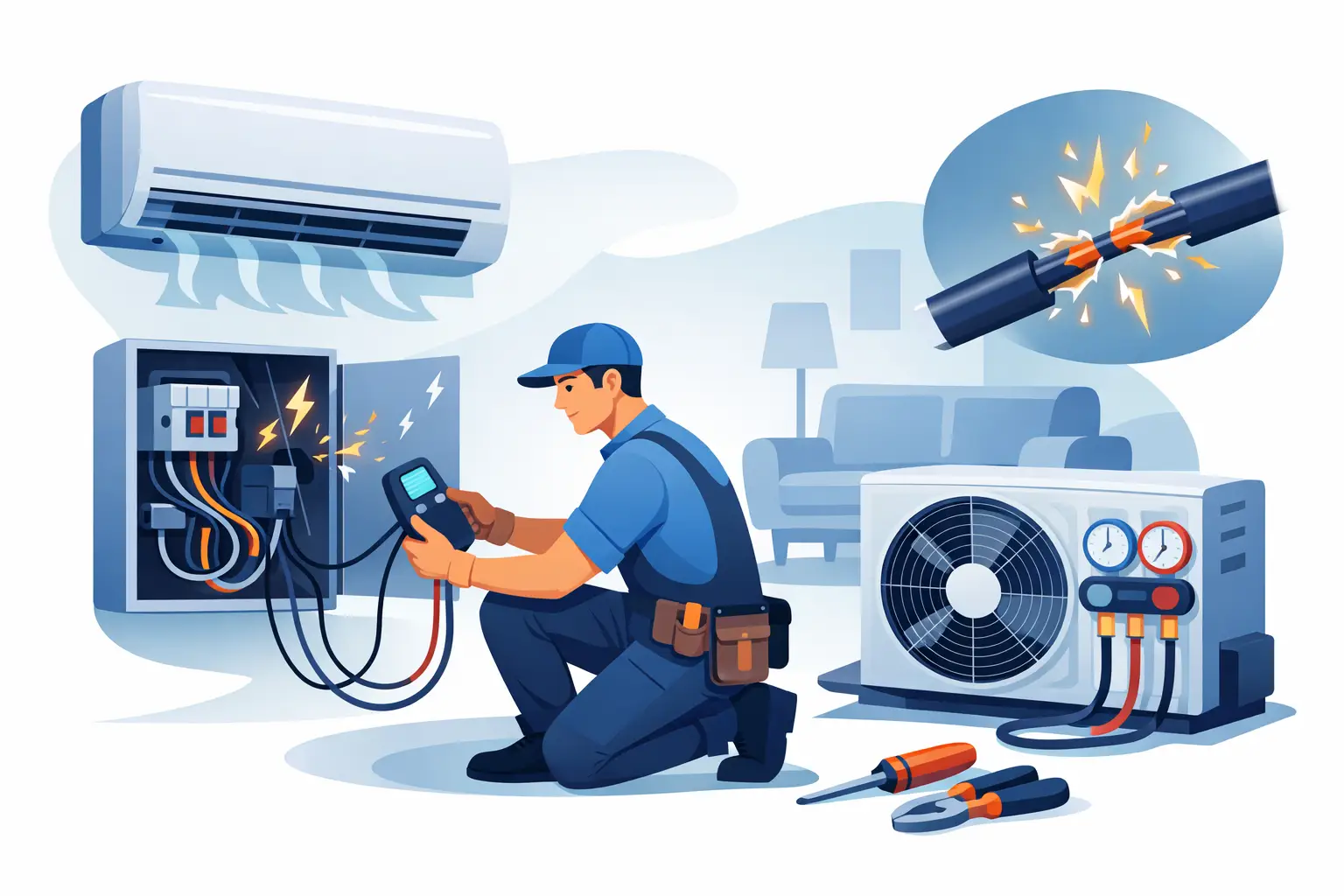
A working air conditioner usually gives you a few warnings before it stops altogether. Maybe the indoor unit clicks but never starts. Maybe the breaker trips every time the system tries to run. Or maybe the outdoor unit is getting power, but the system still will not cool the space. Those are the kinds of problems that often point to an electrical fault, and they need a careful, methodical repair approach.
Electrical issues in air conditioning systems are easy to underestimate. To a homeowner or business owner, the symptom might look simple – the AC is not turning on, the thermostat is blank, or one part of the system is running while another part is not. In practice, the fault could involve low-voltage controls, a damaged capacitor, loose wiring, a failed contactor, a motor problem, or a power supply issue. The right repair depends on accurate diagnosis, not guesswork.
What air conditioner electrical fault repair usually involves
Air conditioner electrical fault repair is the process of finding and correcting failures in the electrical side of the system rather than mechanical issues alone. That can include the thermostat circuit, relays, control boards, terminals, disconnects, capacitors, fan motors, compressor wiring, and the main power feed.
In split systems, ducted systems, and larger commercial setups, the electrical path is not limited to one component. The thermostat sends a signal, the board interprets it, the contactor closes, the capacitor helps motors start and run, and the compressor and fans respond under load. If any one of those parts fails, the system can stop, short cycle, trip safety controls, or operate in an unstable way.
That is why a proper service call starts with testing. A technician should verify voltage, continuity, control signals, component condition, and current draw before replacing parts. Replacing the wrong electrical component can waste time and money and still leave the original problem unresolved.
Common signs of an AC electrical fault
Some warning signs are obvious, and some are easy to dismiss until the system fails completely. If your air conditioner trips the breaker repeatedly, that is one of the clearest red flags. The same applies if you smell burning near the unit, hear buzzing or clicking without startup, or notice the thermostat screen going blank.
Other signs are more subtle. The system may start late, struggle to turn on, cool inconsistently, or shut down after a few minutes. You may also notice that the indoor fan runs but the outdoor unit does not, or the outdoor unit hums without properly starting. Those symptoms can point to a capacitor issue, a control fault, or failing electrical connections.
For commercial properties, nuisance shutdowns can be especially disruptive. A retail shop, office, or small warehouse might not lose cooling all day long, but repeated electrical interruptions can still affect comfort, operations, and energy use. Intermittent faults are often the hardest to diagnose, which makes early testing worthwhile.
The most common causes behind electrical failures
Capacitors are one of the most common failure points in AC systems. When a capacitor weakens or fails, the compressor or fan motor may have trouble starting. That can produce humming, delayed startup, overheating, or a complete no-cool condition. Capacitor failure is common in older systems and in equipment exposed to sustained heat.
Contactors are another frequent issue. These switches control power to major components, and over time the contacts can pit, stick, or fail to close properly. When that happens, the system may not energize consistently, or it may remain stuck in an on or off state.
Loose or damaged wiring is also a regular cause of trouble. Vibration, age, pests, moisture, and previous poor-quality repairs can all affect wiring integrity. A single loose terminal can lead to intermittent faults, overheating, or control board damage.
Then there are control board and thermostat issues. Sometimes the problem is not the high-voltage side at all, but the low-voltage communication between components. A faulty thermostat, blown fuse, damaged board, or broken wire can interrupt the startup sequence even when the rest of the system is mechanically sound.
In some cases, the electrical fault is a symptom rather than the root cause. A failing motor that is drawing too much current can trip breakers. A compressor with internal damage can present like an electrical problem first. That is where experience matters, because the repair may involve more than replacing a single failed part.
Why DIY air conditioner electrical fault repair is risky
It is understandable to check the thermostat settings, the breaker, and the air filter before booking a repair. Those basic checks are reasonable. But once the issue moves into live electrical components, DIY work becomes risky very quickly.
Air conditioning systems combine high voltage, stored electrical charge, and expensive components that are easy to damage with incorrect handling. Capacitors can retain charge. Misdiagnosing a board or motor issue can lead to unnecessary replacements. Even something that looks simple, like a tripped breaker, may be signaling a deeper fault that should not be reset repeatedly without testing.
There is also the warranty and compliance side to consider. Electrical and HVAC work should be handled by qualified professionals, especially when the repair involves opening panels, testing energized components, or replacing major parts. A rushed fix can create safety issues and lead to more expensive repairs later.
How a technician diagnoses the problem
A good diagnosis follows a sequence rather than jumping straight to parts replacement. First, the technician confirms the complaint. Is the system completely dead, partially running, or cycling incorrectly? Then they check the power supply, breaker condition, isolator or disconnect, and thermostat call.
From there, testing usually moves through the control circuit and major components. That may include checking low-voltage output, inspecting the contactor, measuring capacitor values, testing motor windings, reviewing board status codes, and verifying current draw when the system attempts to start.
The age and type of system matter here. A simple wall-mounted split system may have a fairly direct fault path. A ducted or VRV/VRF system can involve more controls, more zones, and more possible failure points. The diagnosis should match the complexity of the equipment.
Once the source of the fault is confirmed, the next step is deciding whether repair is the sensible option. In many cases, it is. Replacing a capacitor, contactor, fuse, or damaged wire can restore reliable operation quickly. But if the fault ties back to a failing compressor, repeated board damage, or an aging system with multiple issues, a broader conversation may be needed.
Repair or replace? It depends on the system
Not every electrical failure means the entire air conditioner is at the end of its life. Many electrical repairs are straightforward and cost-effective, especially on systems that are otherwise in good condition. If the equipment is cooling well, has been maintained properly, and the failed part is isolated, repair is often the smart move.
The decision gets less clear when the system is older, inefficient, or already showing several problems. If you are facing repeated service calls, unstable performance, and rising energy bills, an electrical fault may be part of a larger reliability issue. In that situation, spending money on one repair may only delay a bigger replacement decision.
For homeowners, the balance is usually between repair cost and future dependability. For businesses, downtime also matters. If a commercial system is critical to staff comfort or customer experience, the lowest immediate repair cost is not always the best long-term value.
Preventing future electrical problems
Most electrical faults cannot be prevented forever, but many can be caught earlier with routine maintenance. During service, a technician can inspect terminals, measure capacitor performance, check contactor wear, test motors, and look for signs of overheating or insulation damage before the system fails under pressure.
Clean operation also helps. Restricted airflow, dirty coils, and overworked motors can increase electrical stress across the system. That means what looks like an electrical repair issue can sometimes be linked to maintenance conditions that have been building for months.
If your system has already shown signs like hard starts, intermittent tripping, or delayed cooling, it is worth addressing them early. Waiting for a full breakdown usually narrows your options and adds urgency to the repair.
If you need a clear diagnosis and honest advice, working with an experienced HVAC contractor such as Cool Air Tech can make the process much more straightforward. The goal should be simple – find the actual fault, explain the repair clearly, and restore reliable cooling without overselling what you do not need.
When an air conditioner starts showing electrical warning signs, the best next step is not to hope it clears itself. Small faults rarely stay small for long, and early attention often means a safer, more affordable repair.