
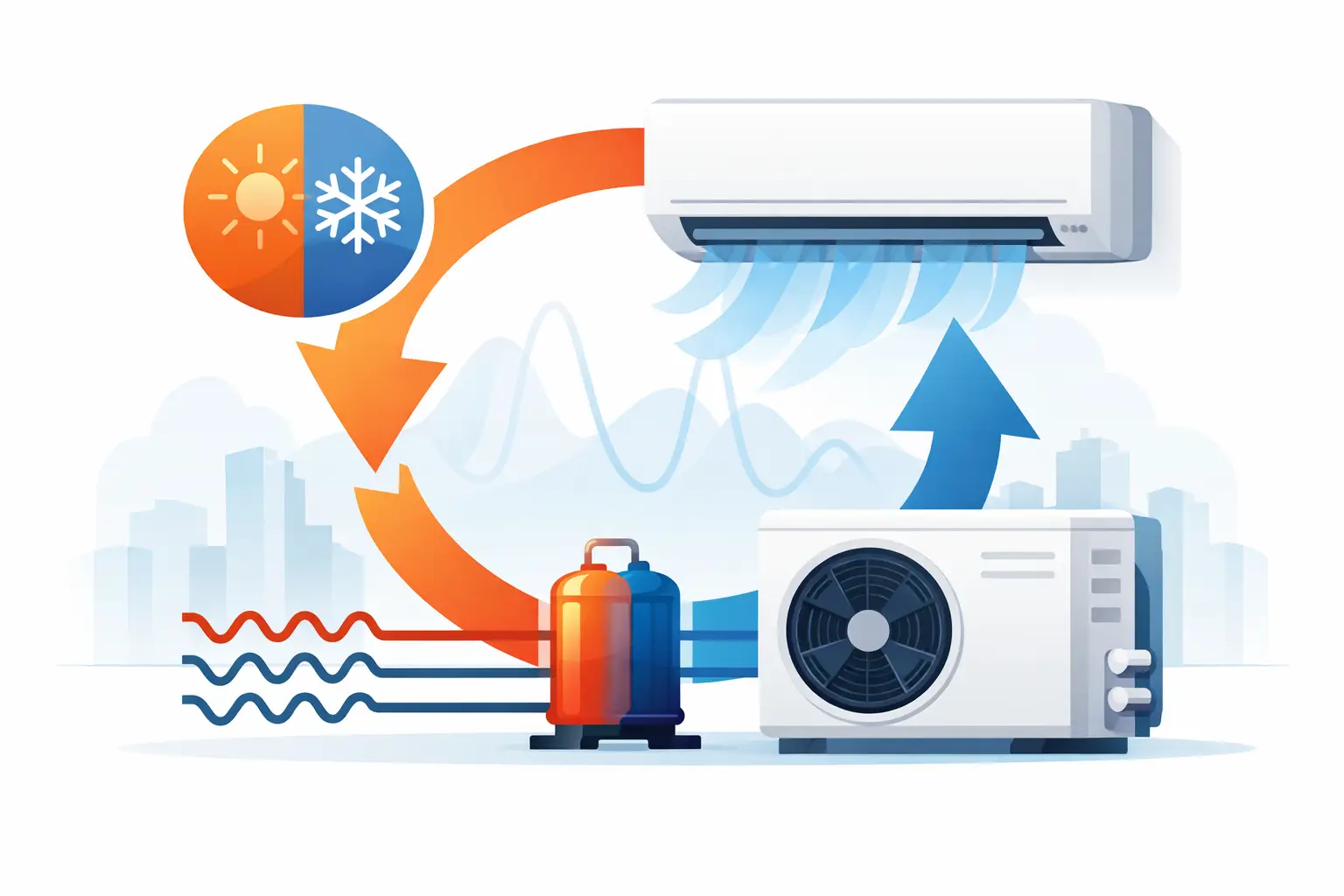
If you have ever noticed that one air conditioner blasts at full power, shuts off, then starts again a short time later, while another seems to just quietly hold the temperature steady, you are already close to understanding how does inverter air conditioning work. The difference comes down to how the system controls its compressor, and that has a direct effect on comfort, power use, noise, and long-term wear.
For most homeowners and business owners, the simple version is this: an inverter air conditioner does not just switch on and off. It adjusts its output up or down to match the room’s actual cooling or heating demand. That is why inverter systems are often more comfortable and more efficient than older fixed-speed models.
How does inverter air conditioning work in simple terms?
The compressor is the part of the system that moves refrigerant and does most of the heavy lifting. In a traditional non-inverter system, the compressor usually runs at one speed only. It turns on at full capacity, reaches the thermostat setting, turns off, and then repeats that cycle throughout the day.
An inverter system works differently. It uses an electronic control system to vary the speed of the compressor motor. Instead of running flat out every time the unit starts, it can speed up when the space is far from the target temperature and slow down as the room gets closer to the set point.
Think of it like driving in city traffic versus using cruise control on a freeway. A fixed-speed air conditioner is constantly accelerating and braking. An inverter system makes smaller adjustments and keeps the temperature more stable.
That steady operation is the core reason inverter technology has become common in modern split systems, ducted systems, multi-split setups, and larger VRV or VRF applications.
What happens inside the system
To understand the process a little better, it helps to know the main components involved. The indoor unit absorbs heat from the air inside the room. The outdoor unit releases that heat outside. Refrigerant carries the heat between the two. The compressor keeps the refrigerant moving through the cycle.
In an inverter air conditioner, incoming electrical power is converted and regulated so the compressor motor can run at variable frequencies. That frequency control changes the motor speed. Lower speed means less cooling or heating output. Higher speed means more output.
The system’s sensors are constantly checking room temperature and, in many models, conditions at the coil and outdoor unit as well. Based on that information, the controller tells the compressor when to ramp up, ease back, or hold a steady speed.
This matters because a room rarely needs 100 percent cooling capacity for long. On a very hot afternoon, the unit may start high to pull the temperature down quickly. Once it gets close to the set point, it can reduce speed and maintain comfort without repeatedly shutting down and starting back up.
Why inverter systems usually use less energy
A lot of people hear “variable speed” and assume the system is always running, so it must be using more electricity. In practice, the opposite is often true.
Starting a compressor from a complete stop takes a lot of energy. Fixed-speed systems do that over and over again. Inverter systems reduce those hard starts by staying on at lower power once the room reaches the desired temperature.
They also avoid overcooling and then waiting for the temperature to drift back up. Because the system can match output more closely to the load, it wastes less energy fighting those big swings.
That does not mean every inverter system will automatically cut bills in every property. Actual savings depend on the size of the unit, insulation levels, layout, thermostat settings, local climate, and how often the system is used. A properly sized inverter unit installed well will usually perform better than an oversized or poorly installed one, even if both use modern technology.
Comfort is where inverter technology really stands out
Lower energy use gets a lot of attention, but day-to-day comfort is often the bigger benefit.
Non-inverter systems tend to create more noticeable temperature swings. You feel a blast of cold air, then the unit shuts off, then the room slowly warms up, and the cycle starts again. Some people find that uneven and distracting, especially in bedrooms, offices, and open-plan living spaces.
An inverter unit is better at holding a narrower temperature range. That means fewer hot and cold patches and more consistent conditions over time. In many systems, it also helps with humidity control because the unit can run longer at lower output rather than stopping completely.
For businesses, that steady control can be useful in areas where customer comfort matters or where staff spend long hours indoors. For homes, it often means quieter nights, fewer abrupt bursts of airflow, and a more even feel from room to room.
Is inverter air conditioning quieter?
Usually, yes.
Because the compressor does not need to slam on at full power as often, inverter systems generally operate more quietly than fixed-speed systems. Indoor units can maintain comfort with gentler airflow, and outdoor units often produce less sudden noise during operation.
That said, quiet performance still depends on product quality and installation standards. A premium inverter unit installed correctly will usually sound different from a budget unit with poor placement, vibration issues, or undersized pipework. Technology helps, but workmanship still matters.
Where inverter systems make the most sense
Inverter technology suits a wide range of properties because most real-world spaces have changing loads throughout the day.
For a single bedroom or living room, an inverter split system can deliver efficient, stable comfort without the stop-start behavior common in older units. In a larger home, inverter ducted systems can respond better to zoning demands, especially when only certain areas need conditioning at a given time.
In commercial settings such as offices, retail stores, and small warehouses, inverter-based systems can be a good fit where occupancy changes throughout the day. If the load rises and falls, variable output is generally more practical than full-capacity cycling.
This is one reason inverter technology is so common in multi-split and VRV or VRF systems. Those applications are built around variable demand across multiple rooms or zones.
The trade-offs to know before you buy
Inverter air conditioning is often the better long-term choice, but there are trade-offs.
The upfront cost is usually higher than a basic non-inverter model. The electronics are more advanced, and better-performing systems often come with a higher purchase price. For many buyers, lower operating costs and improved comfort make that worthwhile over time, but budget still matters.
Repairs can also be more specialized. Inverter systems rely on circuit boards, sensors, and variable-speed controls, so diagnosis is not always as simple as it is with older fixed-speed equipment. That is another reason proper installation and routine maintenance are important.
There is also the question of sizing. Some people assume inverter technology can fix poor system selection. It cannot. If the unit is too small, it may run constantly and still struggle on peak days. If it is too large, efficiency and comfort can still suffer, even with variable speed control.
How does inverter air conditioning work compared with non-inverter models?
The easiest comparison is this: non-inverter systems control temperature by cycling on and off, while inverter systems control temperature by changing compressor speed.
That single difference affects almost everything else. Inverter units tend to deliver steadier temperatures, lower running noise, and better energy performance under normal day-to-day use. Non-inverter units are simpler and may cost less upfront, but they are generally less refined in how they operate.
For many homes and small businesses, the question is not whether inverter technology works. It is whether the system has been selected and installed to suit the space. A quality inverter unit in the wrong capacity or layout will never perform the way it should.
What to look for if you are considering one
If you are comparing systems, focus on more than the word “inverter” on the brochure. Look at the unit’s capacity range, efficiency ratings, sound levels, zoning options, and suitability for the building.
You should also consider how the property is used. A family home with bedrooms occupied at night has different needs than an open office, a retail shop, or a multi-room house with uneven sun exposure. The right recommendation depends on heat load, room size, insulation, ceiling height, window orientation, and how much control you want across separate areas.
That is where practical advice matters more than marketing. A trustworthy contractor should explain what size and system type fit the property, what the running cost expectations are, and whether a split, ducted, multi-split, or VRV/VRF solution makes the most sense. At Cool Air Tech, that kind of straight guidance is what helps customers avoid buying more system than they need, or less than the space requires.
If you are weighing up your options, the best question is not just how the technology works. It is how well the system will work in your property, on your busiest days, and over the years you expect to own it.