
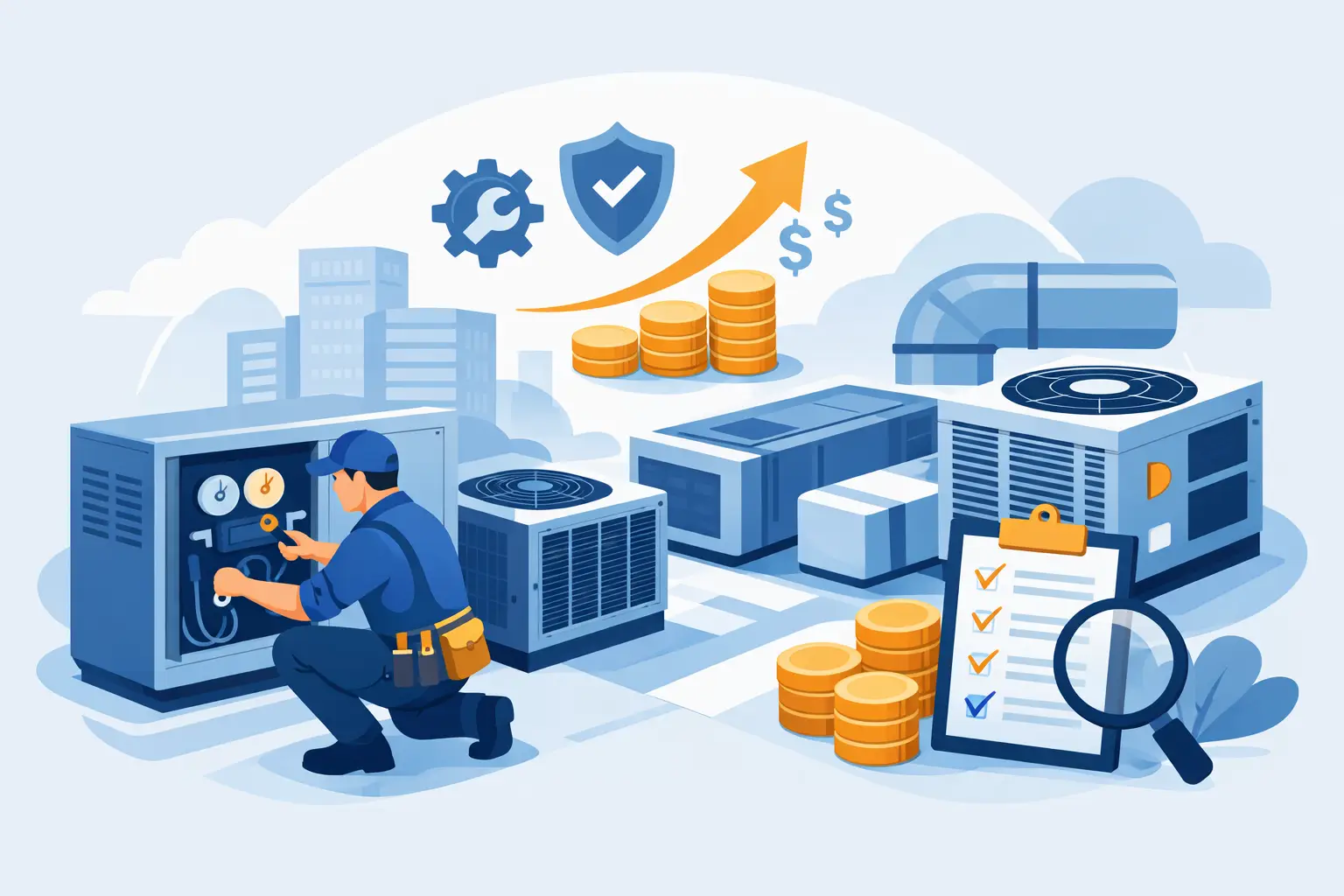
A packed office at 3 p.m. with weak airflow, rising indoor temperatures, and a thermostat that says everything is fine is not just an inconvenience. For most businesses, it means distracted staff, uncomfortable customers, and pressure to fix a problem fast. That is why commercial HVAC maintenance matters so much. It is not just about keeping equipment running. It is about protecting comfort, energy use, operating costs, and business continuity.
Why commercial HVAC maintenance matters
Commercial systems work harder than most people realize. Offices, retail spaces, warehouses, and mixed-use buildings often have long run times, varying occupancy, and changing cooling loads throughout the day. A system that looks fine from the outside can still be losing efficiency because of dirty coils, blocked filters, worn belts, faulty sensors, or refrigerant issues.
When maintenance is skipped, the first sign is not always a total breakdown. More often, it shows up as rooms that never seem to reach set temperature, energy bills that creep higher, excess humidity, poor airflow, or equipment cycling too often. Those problems can linger for months before someone connects them back to the HVAC system.
Regular service helps catch those issues earlier, while they are still manageable. It also gives business owners and property managers a clearer picture of how their equipment is performing and where future repair costs may be heading.
What a proper maintenance visit should include
Not every maintenance visit delivers the same value. A quick filter change and visual check has its place, but it is not the same as a thorough inspection of system performance. Good commercial HVAC maintenance should look at both the mechanical condition of the equipment and how the system is operating in the real building.
Core checks that make a difference
A proper service visit typically includes cleaning or replacing filters, checking coils, inspecting condensate drains, testing electrical connections, measuring refrigerant performance, verifying thermostat and control operation, and assessing airflow. On larger or more complex systems, it may also include zoning checks, damper operation, and review of outdoor and indoor unit communication.
For packaged units, split systems, and VRF or VRV setups, the details vary, but the goal stays the same. The technician should be looking for signs of wear, inefficiency, and developing faults before they turn into emergency callouts.
Maintenance is not one-size-fits-all
A small office with a light occupancy pattern does not need the same schedule as a restaurant, server room, medical tenancy, or retail store with doors opening all day. The right frequency depends on run time, equipment type, indoor air quality demands, and how critical the cooling or heating is to daily operations.
For many commercial sites, twice-yearly maintenance is a solid baseline. Higher-demand spaces may need quarterly service. If a building has older equipment, heavy dust, or known comfort issues, a more proactive plan usually makes financial sense.
The cost of doing nothing
Some businesses delay maintenance because the system is still running and there is no obvious problem. That decision can save money this month, but it often costs more over the course of a year.
Dirty filters and coils force systems to work harder. That can increase energy use, reduce cooling capacity, and place more stress on compressors and fan motors. Loose electrical connections can create intermittent faults that are hard to diagnose later. A blocked drain can cause water damage or indoor humidity issues. Even small problems can have a knock-on effect when ignored.
There is also the cost that does not show up directly on an HVAC invoice. If staff are uncomfortable, productivity drops. If customers leave because a store feels hot or stuffy, revenue can be affected. If a tenant complains repeatedly, it puts pressure on property managers and owners. Good maintenance helps avoid those avoidable disruptions.
Signs your building needs attention now
Some HVAC issues build slowly enough that people get used to them. That is why it helps to know what to watch for between scheduled services.
If certain rooms are consistently warmer or colder than others, if your system is running longer than usual, or if energy bills have increased without another clear reason, it is worth having the equipment checked. Unusual noises, musty smells, frequent thermostat adjustments, visible water near indoor units, and weak airflow are also common warning signs.
Not every symptom means a major repair is coming. Sometimes the fix is straightforward. But waiting too long removes that advantage. A small airflow issue is far easier to resolve than a failed compressor caused by prolonged strain.
Commercial HVAC maintenance and energy efficiency
Energy efficiency is one of the strongest reasons to stay ahead of maintenance. HVAC is often one of the largest energy users in a commercial property, so even modest performance losses can have a noticeable effect on monthly operating costs.
A clean, correctly adjusted system does not have to work as hard to deliver the same result. That means lower power consumption, more stable indoor temperatures, and less wear on key components. In buildings with zoning or variable-speed systems, proper calibration matters even more. If controls are off, the equipment may run inefficiently even when there is nothing mechanically wrong.
This is where experienced service matters. Good technicians do not just look for broken parts. They look for the reasons a system is underperforming. That might be a sensor issue, airflow restriction, poor setpoint strategy, or an early sign that one component is affecting the rest of the system.
Older systems need a different maintenance approach
Maintenance becomes even more important as systems age, but it also needs to be realistic. If a commercial unit is nearing the end of its service life, maintenance should focus not only on keeping it operational, but also on helping the owner plan ahead.
There is a point where repeated repairs stop being cost-effective. That does not mean every older system needs immediate replacement. Some can continue to perform well with careful servicing and a clear understanding of their limits. Others may be consuming too much energy or carrying too much breakdown risk to justify ongoing patchwork repairs.
A dependable contractor should be honest about that balance. Sometimes the right advice is to maintain and monitor. Sometimes it is to start budgeting for an upgrade before a failure forces a rushed decision.
Choosing the right maintenance partner
Commercial HVAC maintenance works best when the provider understands both equipment and business priorities. Technical skill matters, but so does communication. Business owners and property managers need clear explanations, realistic recommendations, and service that aligns with the building’s actual use.
That means maintenance reports should be understandable, not vague. If something is wearing out, you should know whether it is urgent, monitor-only, or likely to become a short-term repair item. If a system is inefficient, the advice should connect to actual operating impact, not generic sales talk.
For small and mid-sized businesses, responsiveness also matters. A contractor who knows your site, your equipment, and your past service history can often spot patterns faster and make better recommendations over time. That continuity has real value.
Cool Air Tech works with businesses that want practical advice, reliable workmanship, and maintenance that supports long-term system performance rather than short-term fixes.
Building a maintenance plan that fits your site
The best maintenance plan is the one that matches the building, the equipment, and the level of risk you can tolerate. A retail space with steady customer traffic may prioritize comfort and fast issue detection. A warehouse may focus more on ventilation, equipment durability, and targeted conditioning in occupied zones. An office may need stable temperature control across multiple areas and better planning around business hours.
That is why a blanket approach rarely works. The service schedule, inspection scope, and follow-up recommendations should reflect how the space is used and what matters most to the people in it.
If your system has been running without a proper check for longer than it should, the smart move is not to wait for a failure that disrupts your day. A well-maintained HVAC system is easier to manage, easier to budget for, and far more likely to support your business when you need it most.