
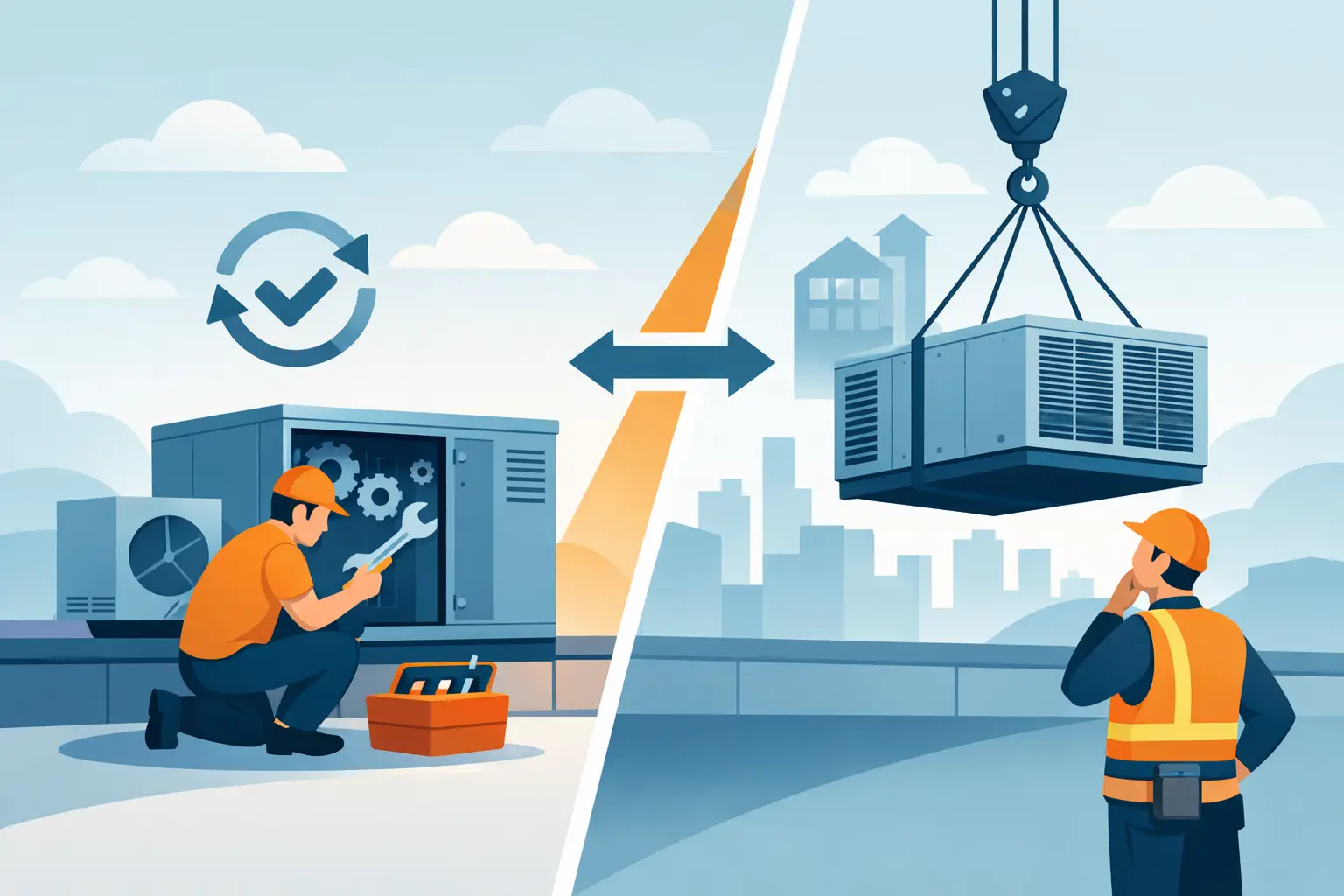
When a rooftop unit fails on a hot workday or a split system starts struggling across multiple zones, the real question is not just how fast it can be fixed. It is whether repair vs replace commercial HVAC makes better business sense for your building, budget, and day-to-day operations.
For most business owners and property managers, this decision sits in the gray area between cost control and risk management. A repair may be the right call if the issue is isolated and the system still has useful life left. Replacement may be the smarter investment if breakdowns are becoming frequent, energy bills are climbing, or the equipment no longer matches how the space is used.
How to think about repair vs replace commercial HVAC
The wrong way to make this decision is to focus only on the immediate invoice. A repair usually costs less upfront, so it can feel like the obvious choice. But if that repair only buys a few months before the next failure, the lower short-term cost can turn into higher total spend.
The better approach is to weigh five factors together: system age, repair history, operating efficiency, parts availability, and the cost of downtime. Commercial HVAC systems support more than comfort. In offices, they affect staff productivity. In retail, they influence customer experience. In warehouses and specialty spaces, they can affect equipment, stock, or compliance.
That is why the answer is rarely one-size-fits-all. A ten-year-old system with a failed capacitor is very different from a twenty-year-old unit with compressor issues, poor airflow, and rising utility costs.
When repair is usually the better option
Repair often makes sense when the system is still within a reasonable service life and the problem is limited to one or two components. If the unit has been maintained properly, has not needed frequent callouts, and still cools the space effectively, a targeted repair can be the most practical move.
This is especially true for issues like failed contactors, sensors, fan motors, control faults, or refrigerant leaks that can be identified and corrected without major system disruption. In many cases, restoring proper airflow, cleaning coils, recalibrating controls, or replacing a worn part can bring performance back to normal.
Repair is also worth strong consideration if your business needs time to plan a capital upgrade. A temporary repair can be reasonable if it is done with clear expectations and a realistic timeline. The key is honesty about whether the repair is extending useful life or simply delaying a replacement that is already overdue.
Signs a repair may be enough
A repair is often the better choice when the unit is under 10 to 12 years old, the issue is isolated, parts are available, and energy use has remained fairly stable. It also helps if indoor comfort complaints are limited and the equipment still suits the space.
For example, if a small office has a ducted system that has performed well for years and suddenly develops a control board issue, replacing the board is usually more sensible than replacing the full system. The same logic applies to a retail shop with a VRF zone issue that can be repaired without affecting the entire installation.
When replacement is the smarter long-term move
Replacement becomes more compelling when repairs are stacking up, performance is inconsistent, or the system is clearly behind current efficiency standards. Commercial equipment does not fail all at once every time. More often, it declines in stages. You start seeing warm spots, longer run times, higher bills, more noise, and repeated service visits.
At that point, replacement is not only about avoiding one more repair. It is about resetting reliability, operating cost, and system fit for the building.
Older systems can also create a hidden financial drag. Even if they are still running, they may be using more power than necessary, struggling to maintain set temperatures, or relying on refrigerants and components that are harder and more expensive to source. A system that works poorly can still cost you a lot.
Common signs replacement should be on the table
If your commercial HVAC system is 15 years old or more, needs major component replacement, breaks down several times a year, or cannot maintain comfort across the space, replacement deserves serious consideration. The same goes for systems that are oversized, undersized, or no longer aligned with the building layout after a remodel or change in occupancy.
A business that has expanded staff, added heat-producing equipment, or reconfigured rooms may be asking an old system to do a job it was never designed to handle. In that case, replacing like-for-like is not always enough. The system design itself may need to change.
Cost is not just repair bill vs install quote
One of the biggest mistakes in the repair vs replace commercial HVAC decision is comparing only the technician’s repair estimate with the replacement price. That leaves out the costs that actually shape the long-term outcome.
You also need to think about energy consumption, disruption to business, repeat service calls, after-hours emergency fees, and the effect on staff or customers when conditions are uncomfortable. A low-cost repair that leads to another shutdown in peak season can be more expensive than it first appears.
This is where lifecycle thinking matters. If a repair costs a meaningful percentage of replacement cost and does not solve the broader reliability issue, replacement often becomes easier to justify. There is no universal percentage rule that fits every building, but once repair costs start climbing while confidence in the system drops, it is time to step back and reassess.
Efficiency and control matter more than they used to
Commercial HVAC replacement is not just about getting a new machine. In many buildings, it is a chance to improve zoning, control strategy, and energy performance.
Modern systems can deliver better part-load efficiency, quieter operation, and more precise temperature management. For offices and mixed-use spaces, that can mean fewer hot and cold complaints. For retail and hospitality settings, it can support a more consistent customer environment. For businesses watching operating expenses closely, lower energy use can materially change the economics of replacement.
This is particularly relevant in buildings with older ducted, split, multi-split, or VRV/VRF setups that were installed around earlier occupancy patterns. If your current system is running constantly to maintain comfort, newer equipment and better design may solve more than one problem at once.
Downtime risk should carry real weight
A repair may look cheaper until the system fails again on the hottest week of the year. That is why downtime risk needs to be part of the decision, especially for customer-facing businesses and spaces where climate control supports operations.
If your current equipment is unreliable and you cannot afford surprise outages, replacement often has value beyond efficiency. It provides planning. You can schedule the work, prepare staff, and avoid being forced into an emergency decision when options are limited.
Emergency replacement usually costs more and gives you less control over timing. Planned replacement tends to produce better outcomes because system selection, installation scope, and staging can be handled properly.
Why a professional assessment matters
The repair-or-replace decision should come from actual system condition, not guesswork. A proper commercial HVAC assessment should look at equipment age, fault history, compressor condition, refrigerant pressures, electrical components, airflow, control performance, and how the current system matches the building load.
It should also include a straightforward conversation about your goals. Some clients want the lowest short-term spend. Others want to reduce operating costs, improve comfort, or avoid disruptions over the next five to ten years. The right recommendation depends on that context.
At Cool Air Tech, that usually means giving clients a practical view of both paths rather than pushing replacement by default. Sometimes the honest answer is that a repair is the sensible move. Other times, continued repairs are just delaying a more cost-effective upgrade.
A simple way to decide
If the system is relatively young, the fault is isolated, and the unit still performs well, repair is often the right call. If the system is older, inefficient, unreliable, or no longer suited to the space, replacement usually puts you in a stronger position.
The key is not to wait until the choice disappears. Once repeated breakdowns start affecting your business, you are no longer deciding from a position of control. You are reacting.
A good HVAC decision should protect comfort, costs, and business continuity at the same time. If you are weighing repair against replacement, the most useful next step is a clear assessment of what your current system can realistically deliver from here, and for how long.