
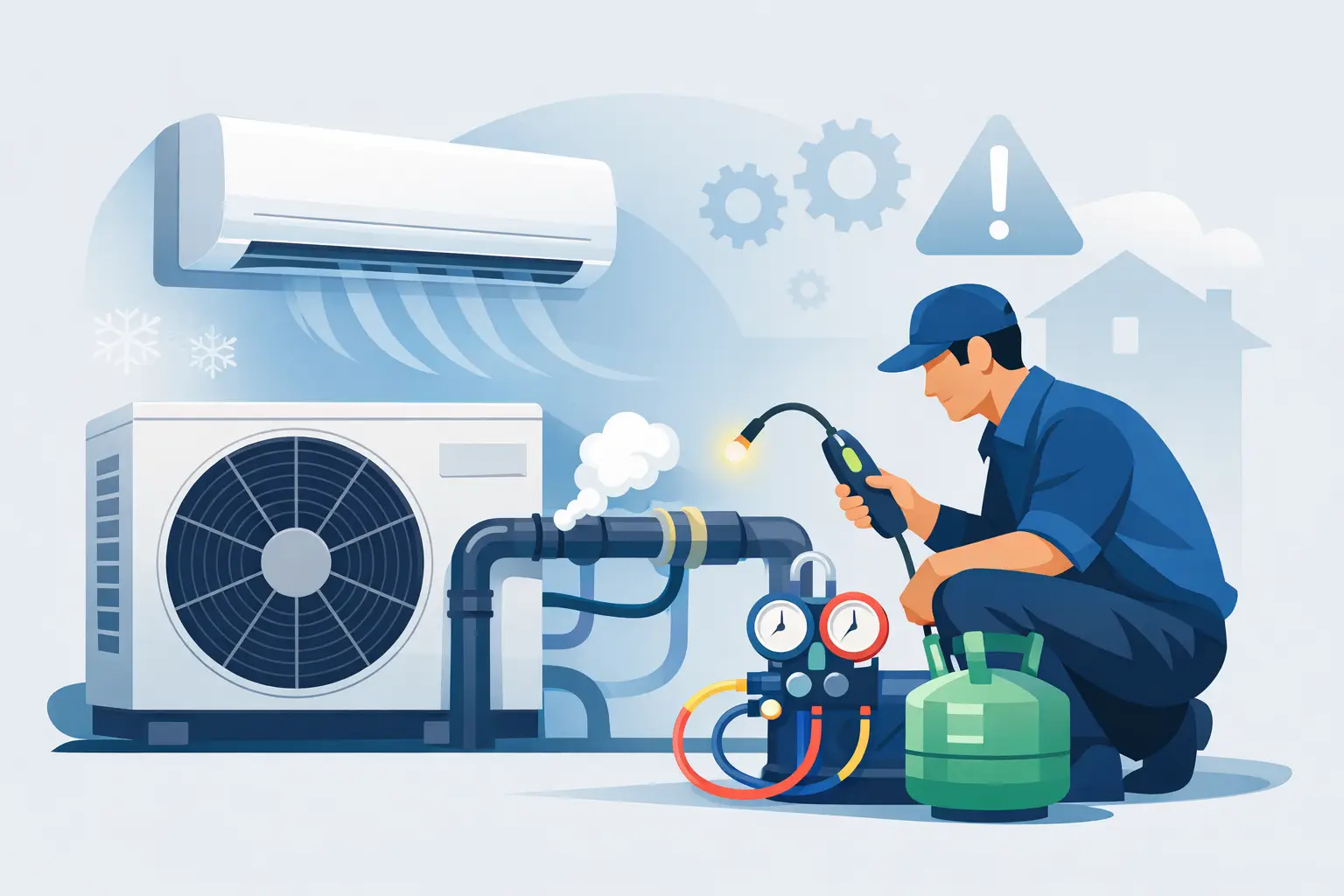
A system that still blows some cool air can still have a refrigerant leak. That is why knowing how to spot refrigerant leaks matters: waiting for the air conditioner to stop working completely can mean higher energy bills, reduced comfort, and a more involved repair.
Refrigerant is the fluid that carries heat out of your home or business. It operates in a sealed system, so it should not need routine refilling. When refrigerant is low, the issue is not that the system has “used it up.” It means refrigerant has escaped through a leak that needs to be located and repaired.
The Most Common Signs of a Refrigerant Leak
A refrigerant leak can be small and gradual or large enough to affect cooling within days. The symptoms often overlap with other air conditioning problems, such as a dirty filter, a failing fan, or ductwork issues. Still, several warning signs are particularly worth taking seriously.
Your Air Conditioner Takes Longer to Cool
If your system runs for long periods without bringing rooms down to the thermostat setting, low refrigerant may be the cause. With too little refrigerant circulating through the coils, the equipment cannot absorb and release heat as effectively.
You might notice this first during a heat wave, when the system has less capacity to spare. In a home, bedrooms furthest from the indoor unit may feel warm while nearby areas are only moderately cool. In a small business, staff or customers may notice uneven comfort across offices, retail areas, or meeting rooms.
Long run times do not automatically confirm a leak. Poor insulation, an undersized system, blocked outdoor airflow, and extremely hot weather can also contribute. But if the performance has noticeably changed from previous seasons, a professional inspection is sensible.
Air From the Vents Feels Less Cool
Put your hand near a supply vent after the system has been running for 10 to 15 minutes. Air that feels mildly cool rather than properly chilled can point to low refrigerant. This is especially noticeable on split systems that previously cooled a room quickly.
Do not judge the system based on one vent alone. A blocked filter, closed register, or duct restriction can affect airflow in a specific room. Check whether the issue is present throughout the property and whether the fan airflow feels weaker than usual.
Ice Forms on the Indoor or Outdoor Unit
Frost or ice on refrigerant lines, the indoor evaporator coil, or the outdoor condenser can be a strong warning sign. Low refrigerant lowers pressure inside the system, which can make the evaporator coil cold enough to freeze moisture from the air.
Ice may seem like evidence that the system is cooling well, but it is the opposite. A frozen coil restricts airflow and can eventually leave you with little or no cooling. Turn the system off if you see ice and allow it to thaw naturally. Do not chip at the ice or use sharp tools near coils and refrigerant lines.
A dirty air filter or blower problem can also freeze a coil, so testing is required to identify the underlying cause accurately.
You Hear Hissing or Bubbling Near Refrigerant Lines
A hissing sound can occur when refrigerant escapes through a small opening under pressure. A larger leak or one in a lower-pressure area may create a bubbling or gurgling noise instead. These sounds are often heard near the indoor unit, outdoor unit, line set connections, or refrigerant piping on larger ducted and VRF systems.
HVAC equipment makes normal operating sounds, including fan noise, compressor vibration, and occasional clicking. What matters is a new, persistent noise that appears alongside reduced cooling. Avoid trying to tighten fittings or open the equipment yourself. Refrigerant systems operate under pressure and require qualified handling.
Your Energy Bills Rise Without a Clear Reason
An air conditioner with low refrigerant must work harder to move the same amount of heat. That can increase runtime and electricity use, even before comfort drops dramatically.
Compare recent bills with the same period last year, allowing for changes in weather, occupancy, or thermostat settings. A steady increase combined with longer cooling cycles is more meaningful than one unusually high bill. Commercial operators should also pay attention to systems running outside normal schedules or zones that never seem to satisfy their temperature settings.
The System Starts and Stops More Often
Short cycling happens when an air conditioner turns on and off repeatedly before completing a normal cooling cycle. Low refrigerant can contribute to this behavior, although it is not the only explanation. Thermostat placement, electrical faults, oversized equipment, and dirty coils can cause similar symptoms.
Repeated short cycling puts additional stress on the compressor, which is one of the most expensive components in an air conditioning system. Prompt diagnosis can help prevent a smaller refrigerant issue from becoming a major equipment repair.
Where Refrigerant Leaks Usually Occur
Leaks are not always visible. They can develop over time through vibration, corrosion, wear at connections, physical damage to tubing, or poor installation practices. In coastal or humid environments, corrosion can be a greater concern, particularly where coils or connections are exposed to moisture and contaminants.
Technicians commonly inspect flare fittings and brazed joints, service valves, indoor and outdoor coils, refrigerant line connections, and areas where copper tubing has rubbed against another surface. On ducted, multi-split, and VRF/VRV systems, longer piping runs and multiple connection points create more places that need careful assessment.
An oily residue around a connection can sometimes indicate a leak because refrigerant carries oil through the system. However, no visible oil does not mean there is no leak. Many leaks are too small or too inaccessible to identify by sight alone.
Why Adding Refrigerant Is Not a Complete Repair
If a contractor simply adds refrigerant without finding the reason it was low, the cooling may improve temporarily. But the refrigerant will continue to escape, and the system may return to the same condition weeks or months later.
A proper repair generally involves confirming the symptoms, locating the leak, repairing or replacing the affected component, pressure testing the system, evacuating moisture and air from the lines, and recharging it to the manufacturer’s specified level. The exact process depends on the system type, refrigerant, leak location, and condition of the equipment.
For an older unit with a leaking coil, the best option is not always a repair. Coil replacement can be cost-effective on a newer, otherwise reliable system. On an aging unit with multiple issues or an outdated refrigerant type, replacement may offer better long-term value. An honest assessment should explain both paths, including likely cost, expected reliability, and efficiency implications.
How Professionals Confirm a Refrigerant Leak
A qualified HVAC technician uses more than one method because no single test is right for every situation. Visual inspection can identify damaged piping, oil residue, and obvious corrosion. Electronic leak detectors can sense refrigerant escaping from small leaks, while pressure testing with dry nitrogen helps assess the integrity of the sealed circuit.
For difficult leaks, technicians may use an approved trace gas method or ultraviolet dye where appropriate. They also measure operating pressures, temperature differences, airflow, and electrical performance. These readings help distinguish a true refrigerant issue from an airflow or mechanical problem.
In the United States, refrigerant handling is regulated and should be performed by properly certified professionals. Besides protecting your equipment, professional service helps prevent refrigerant from being released unnecessarily into the environment.
What You Can Do Before the Technician Arrives
You do not need to diagnose the leak yourself, but a few observations can make the service visit more efficient. Note when the cooling problem began, whether it occurs in every room or zone, and whether you have seen ice, water, or error codes. If possible, record short videos of unusual sounds and take a photo of the indoor or outdoor unit’s model number.
Replace or clean the air filter if it is due for service, and make sure the outdoor unit has clear space around it. Do not remove access panels, bend refrigerant tubing, or attempt to use store-bought refrigerant products. Those steps can create safety risks, damage equipment, and make accurate diagnosis more difficult.
If the unit is frozen, switch cooling off and run the fan only if your system allows it. Once thawed, leave the system off until it can be assessed if the issue returns quickly.
A refrigerant leak is rarely a problem that improves on its own. Paying attention to reduced cooling, ice buildup, unusual sounds, and unexplained energy use gives you a better chance to address the issue before compressor damage or a complete loss of cooling disrupts your home or business.