
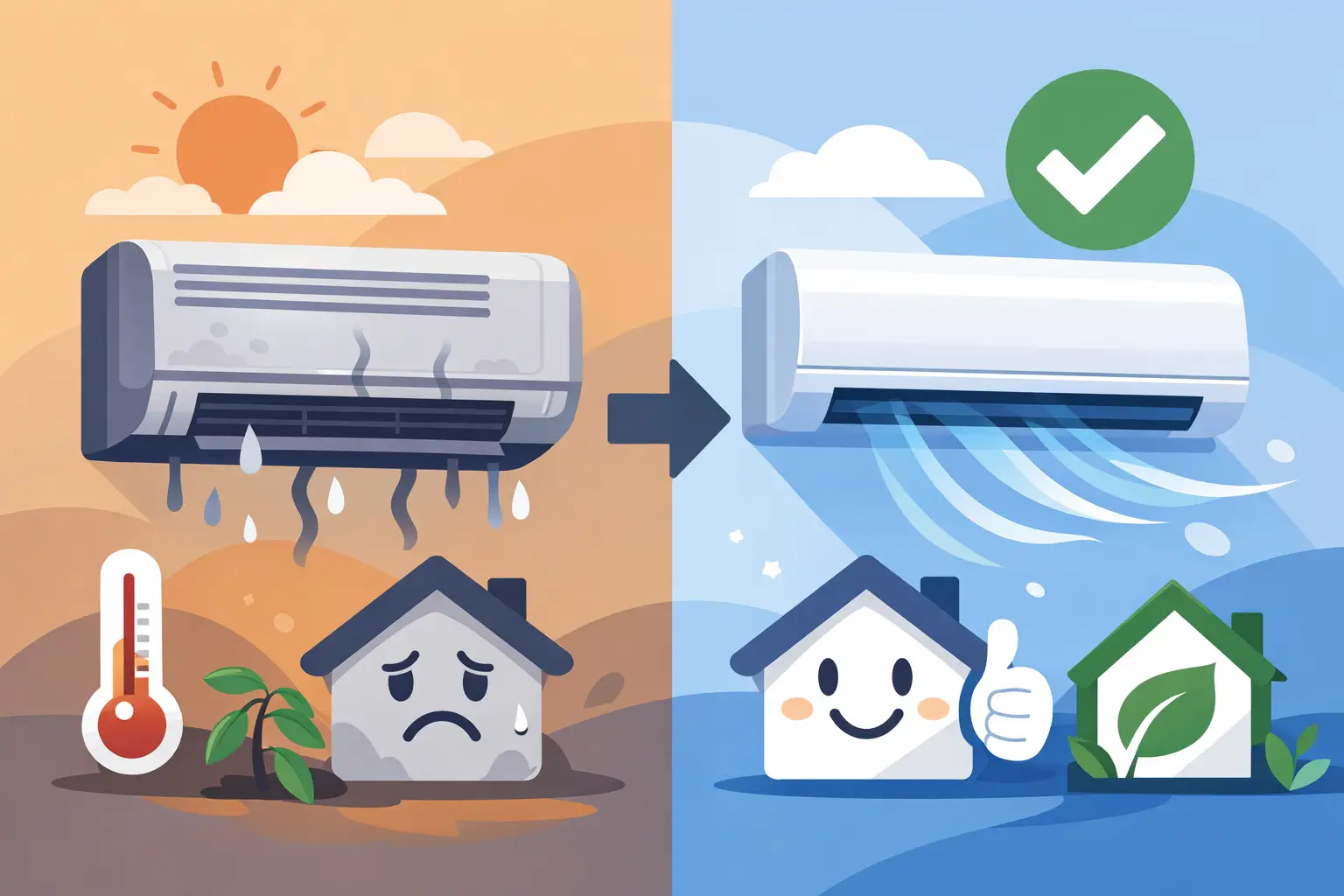
A system can seem to fail all at once: the living room will not cool down, one office is stuffy, and the utility bill arrives higher than expected. In reality, most equipment gives warning well before a complete breakdown. The top signs AC replacement is the right move usually come down to age, repair history, energy use, and whether the system can still keep the property consistently comfortable.
Replacing an air conditioner is a significant decision, and a repair is often the sensible first option. But continuing to spend money on an unreliable or undersized system can cost more over time while leaving your home or business uncomfortable. The goal is not to replace equipment prematurely. It is to make a practical decision based on the condition of the system and the needs of the space.
Top signs AC replacement should be considered
Your AC is 12 to 15 years old or more
Well-maintained air conditioners can provide many years of service, but age changes the repair calculation. Once a system is around 12 to 15 years old, major components such as the compressor, outdoor fan motor, coil, or control board may be nearing the end of their service life.
Age alone does not mean replacement is mandatory. A lightly used system that has been serviced regularly may still have useful life left. However, an older unit with recurring faults, declining performance, or expensive parts is usually a candidate for an upgrade. Newer systems also tend to offer better efficiency, quieter operation, and more precise temperature control than equipment installed a decade or more ago.
Repairs are becoming frequent or expensive
One repair does not automatically justify a new system. A failed capacitor, blocked drain, worn contactor, or minor electrical issue can often be corrected at a reasonable cost. The concern is a pattern of callouts, especially when each repair addresses a different aging component.
A helpful rule is to compare the repair cost with the value and remaining life of the equipment. If a major repair costs a substantial portion of a replacement system, it is worth asking whether that money would be better applied to a dependable new installation. This is especially true if the repair does not address poor efficiency, uneven cooling, or an undersized system.
For a business, reliability carries an additional cost. An unexpected failure can disrupt staff, customers, stock, and daily operations. Planned replacement gives you more control over timing than an emergency changeout during the hottest week of the year.
Energy bills keep rising without a clear explanation
A gradual increase in cooling costs can point to an air conditioner that is working harder to achieve the same result. Dirty filters and coils, duct leakage, poor insulation, and thermostat settings can all contribute, so a professional assessment should come before assuming the unit needs replacement.
Still, older systems commonly lose efficiency as components wear and technology falls behind current standards. If the AC runs for long periods, cycles repeatedly, or struggles on moderate days, the operating cost can become difficult to justify. A properly sized modern split system, ducted system, or multi-zone solution may reduce wasted energy while improving comfort.
The key word is properly sized. Installing a larger unit is not automatically the answer. Oversized equipment can cool a room too quickly, cycle on and off excessively, and remove less humidity. A load assessment considers the property layout, insulation, sun exposure, occupancy, windows, and room usage before a recommendation is made.
Some rooms are comfortable while others are not
Uneven cooling is one of the most frustrating signs of an AC problem. Bedrooms may stay warm while the main living area is cold, or an office meeting room may become uncomfortable every afternoon. In some cases, the cause is repairable: a blocked filter, damaged duct, closed damper, refrigerant issue, or poorly positioned indoor unit may be limiting airflow.
But if the system has always struggled to serve the entire property, replacement may offer a better long-term answer. A single split system may not be suitable for a large or multi-level home. An older ducted system may lack zoning, making it expensive to cool areas that are not in use. Multi-split, ducted zoning, and VRF/VRV-style commercial systems can give larger properties more targeted control when designed correctly.
The system is noisy, leaky, or producing poor airflow
New or worsening noises should not be ignored. Rattling can indicate loose panels or mounting issues, while grinding, squealing, and loud buzzing may point to mechanical or electrical faults. Water around the indoor unit can come from a blocked condensate drain, but persistent leaks can also cause ceiling, wall, or flooring damage if left unresolved.
Weak airflow is another issue that deserves attention. Start with the basics: replace or clean filters as recommended and make sure vents are open and unobstructed. If airflow remains poor after maintenance, the issue may involve the blower, ductwork, evaporator coil, or system design. When an older system has multiple performance issues at once, replacement can be more reliable than piecemeal repairs.
The refrigerant or parts are becoming a problem
Some older air conditioners use refrigerants that are no longer common or are more costly to source and service. A refrigerant leak should always be located and repaired where possible, rather than simply refilling the system. Repeated loss of refrigerant is not normal operation, and it can quickly turn into an expensive cycle.
Parts availability matters too. If a key component is discontinued, back-ordered for an extended period, or disproportionately expensive, replacement may be the more practical path. A newer system can provide access to current components, manufacturer support, and warranty coverage, assuming it is installed and maintained according to requirements.
When repair still makes more sense
Replacement is not always the best recommendation. If your AC is relatively new, has a clear and isolated fault, and has otherwise cooled the space well, a repair is commonly the right choice. Routine maintenance can also solve many issues that look serious at first, including poor airflow, drainage problems, dirty coils, and electrical wear.
The same applies when comfort problems are caused by factors outside the equipment. Gaps around doors, inadequate insulation, unshaded west-facing windows, or changes to how a space is used can place more load on an air conditioner. Addressing those conditions may improve performance without replacing the entire system.
A dependable HVAC assessment should explain what has failed, what can be repaired, the expected cost, and the likely condition of the remaining equipment. Honest advice includes both options, not just the most expensive one.
Choosing the right replacement system
If replacement is the sensible next step, the best system depends on the property. A wall-mounted split system can be an efficient, practical solution for a single room, apartment, or smaller open-plan area. Multi-split systems serve several rooms with separate indoor units, while ducted air conditioning can provide a cleaner look and whole-home comfort with zoning options.
For commercial spaces with multiple rooms, changing occupancy, or different temperature demands, a professionally designed VRF/VRV system may offer the flexibility and control required. The right choice should account for capacity, layout, noise expectations, electrical requirements, placement of indoor and outdoor units, and future servicing access.
Installation quality matters just as much as the equipment selected. Correct refrigerant piping, drainage, electrical work, airflow setup, and commissioning help protect efficiency, comfort, and equipment life. A low initial price can become costly if shortcuts lead to noise, leaks, poor performance, or early component failure.
Before making a decision, request clear information about the recommended system, scope of installation, warranty terms, expected timeline, and any upgrades needed to support the new equipment. This gives you a realistic comparison between another repair and a planned replacement.
If your air conditioner is becoming harder to rely on, do not wait for a total failure to start the conversation. A qualified assessment can clarify whether a targeted repair will restore performance or whether a new, properly designed system will give your property more reliable comfort and better control over running costs.