
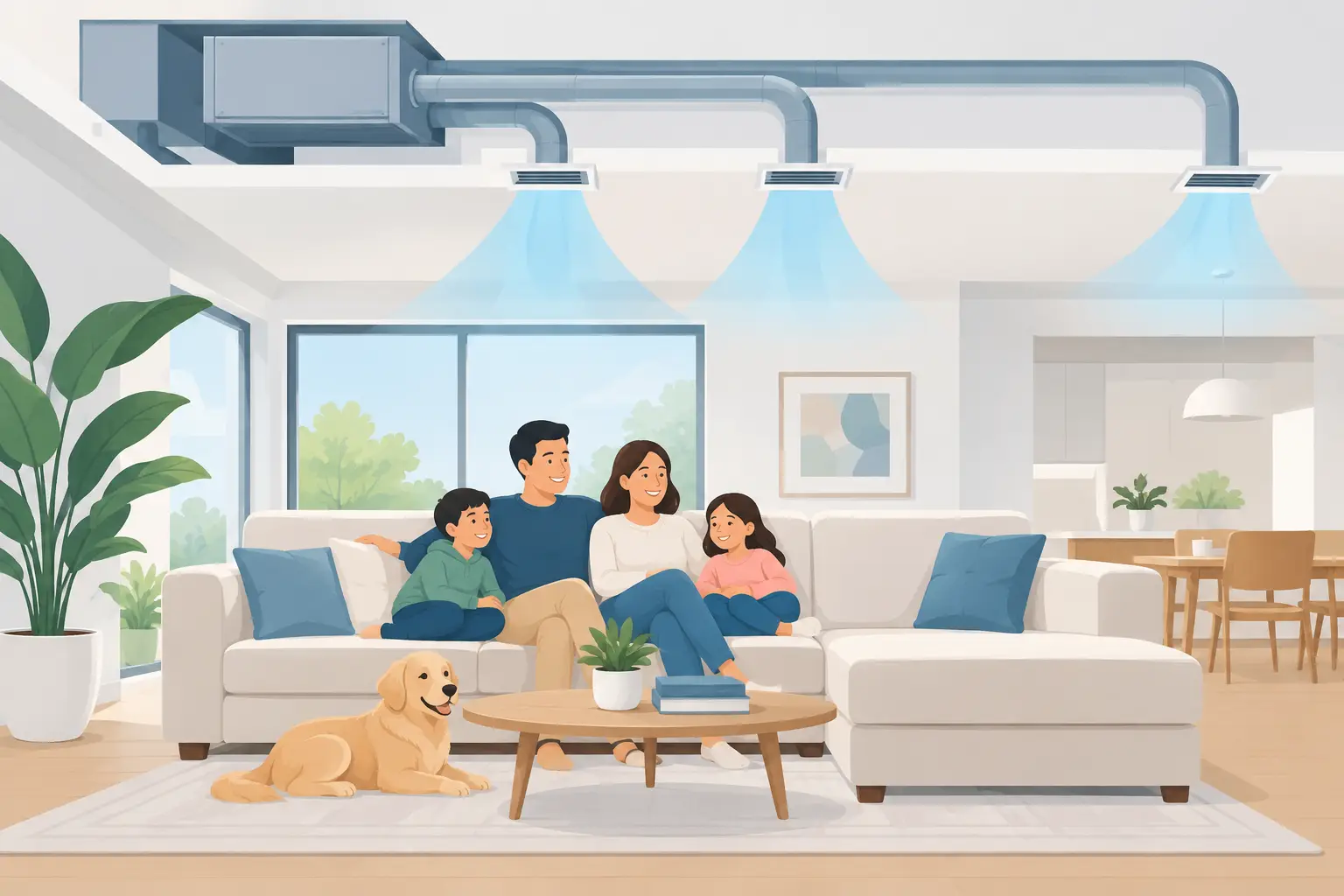
A family home rarely needs the same level of heating or cooling in every room at the same time. Bedrooms may need conditioning overnight, the kitchen may heat up in the late afternoon, and an unused guest room does not need to run all day. The best ducted features for families address those real routines, helping the system deliver comfortable temperatures without wasting energy or creating unnecessary noise.
A ducted HVAC system can provide a clean, whole-home solution, with the indoor equipment concealed and air delivered through ceiling or floor registers. But not every ducted installation performs the same way. The right design depends on the home’s layout, insulation, number of occupants, and how each area is used.
Best ducted features for families to prioritize
Individual zoning control
Zoning is often the most valuable ducted feature for a busy household. It separates the home into independently controlled areas, such as living spaces, the main bedroom wing, children’s bedrooms, and a home office. Dampers inside the ductwork open or close according to the zones selected at the thermostat or controller.
This means you can cool the family room during the day without conditioning empty bedrooms. At night, you can run the sleeping zones while reducing conditioning in the kitchen and living areas. The benefit is not only comfort. Properly planned zoning can reduce unnecessary runtime and give family members more control over the rooms they use.
More zones are not automatically better. A small, open-plan home may work well with two zones, while a larger two-story home may need four or more. Too many poorly planned zones can make controls confusing and may affect airflow if the equipment and ductwork are not designed for low-demand operation. The best approach is to zone around actual living patterns, not simply divide the floor plan into equal sections.
Smart controls with simple scheduling
A ducted system should be easy to operate for everyone in the household. Smart thermostats and app-based controls allow you to adjust temperatures, switch zones on or off, and set schedules from a phone or central wall controller.
Scheduling is particularly useful for families with predictable routines. You might set the system to prepare living areas before everyone gets home, then automatically move to bedroom zones before bedtime. Vacation settings can also prevent the home from becoming excessively hot or cold while limiting energy use.
Smart controls are useful only when they remain straightforward. Look for clear zoning labels, simple temperature adjustments, and schedules that are easy to override. Complicated settings tend to get ignored, which limits the value of the feature. A qualified installer should take time to explain the controller after installation and confirm that the programmed zones match the household’s needs.
Quiet indoor and outdoor operation
Noise matters more in a family home than many buyers expect. A loud outdoor condenser can affect a patio, neighboring properties, or a child’s bedroom. Noisy supply registers and return-air grilles can also become noticeable during quiet evenings.
Quiet operation starts with selecting appropriate equipment, but installation quality is equally important. Correct duct sizing, well-supported flexible duct, properly located return-air grilles, and suitable air velocities help prevent whistling, rattling, and rushing sounds. Equipment should also be positioned with practical access and consideration for bedrooms, outdoor entertaining areas, and property boundaries.
If quiet performance is a priority, ask how the proposed system will manage noise at both the indoor vents and the outdoor unit. It is easier to address these decisions during design than after the system is installed.
Effective filtration and return-air design
Children, pets, cooking, and everyday activity can all affect indoor air quality. A ducted system with accessible, good-quality filtration helps capture dust and airborne particles before air is recirculated through the home. It also helps protect the system itself by keeping the indoor coil and blower cleaner.
The filter must suit the equipment and be maintained regularly. A very restrictive filter can reduce airflow if the system was not designed for it, which may increase running costs and place strain on the equipment. Your HVAC contractor can recommend a filtration level that balances particle capture with proper airflow.
Return-air placement is just as important. A return grille needs to draw air efficiently from the parts of the home being conditioned. In a large house, one poorly placed central return may leave some rooms feeling stuffy or slow to respond. Well-planned return paths help maintain even circulation and prevent closed bedroom doors from disrupting airflow.
Variable-capacity equipment
Traditional single-stage systems generally run at full output whenever they are on. Variable-capacity or inverter-driven ducted systems can adjust their output more gradually to match the home’s changing demand. On a mild day, the system may run at a lower level rather than repeatedly turning on and off at full capacity.
For families, this can mean steadier temperatures, quieter operation, and improved efficiency during long cooling or heating periods. It can be particularly beneficial in homes where only one or two zones are often active.
There is a trade-off. Variable-capacity equipment can cost more upfront, and its performance still relies on a compatible control setup, correct duct design, and accurate sizing. It is not a substitute for a proper load calculation. Still, for a family that uses heating and cooling often, it can be a worthwhile long-term feature.
Right-size capacity, not oversized capacity
A larger HVAC system is not necessarily a more powerful solution. Oversized equipment can cool or heat the home too quickly, leading to short cycles, uneven temperatures, and less effective humidity control in cooling mode. Undersized equipment may run continuously during extreme weather and struggle to keep key rooms comfortable.
Capacity should be based on more than square footage. A professional assessment should account for ceiling height, insulation, window size and orientation, sun exposure, occupancy, appliances, local climate, and the number of stories. A west-facing family room with large windows can have a very different cooling load from a shaded bedroom of the same size.
This assessment should also consider future changes. If you plan to convert a garage, add a nursery, build an addition, or create a regular work-from-home space, mention it before the system is selected. Designing with those likely needs in mind can prevent expensive changes later.
Features that depend on your home
Some ducted upgrades make sense only in certain properties. A two-story home may benefit from separate temperature control by floor because heat rises and upstairs rooms often have different exposure. Homes with high ceilings or open stairwells may need more careful airflow planning to avoid hot and cold pockets.
A home with several closed bedrooms may need additional return-air pathways, while an open-plan home may benefit more from thoughtfully positioned supply registers. If family members have allergies, enhanced filtration may be a higher priority than advanced scheduling. If the household is often away, smart controls and energy-saving schedules may offer the most value.
The goal is not to add every available option. It is to build a system that suits the way your family actually lives.
Questions to ask before approving a ducted system
Before accepting a proposal, ask how the contractor determined the system capacity and whether the quote includes zoning, controls, ductwork, registers, electrical work, and commissioning. A transparent quote should make clear what is included and identify any site-specific factors that could affect the final scope.
Ask where the indoor unit, outdoor unit, return grilles, and supply registers will be located. These decisions influence access for maintenance, noise levels, room appearance, and system performance. It is also reasonable to ask how filters are accessed, what maintenance is recommended, and how warranty support will be handled.
Finally, ask how the system will be tested after installation. Commissioning should verify airflow, zone operation, temperature response, drainage, and controller settings. A ducted system is a long-term part of the home, so careful setup matters as much as the equipment selected.
A well-designed ducted system should fit around family life rather than require family life to fit around it. Choose the features that solve your everyday comfort problems, and make sure the design, installation, and aftercare support them for years to come.