
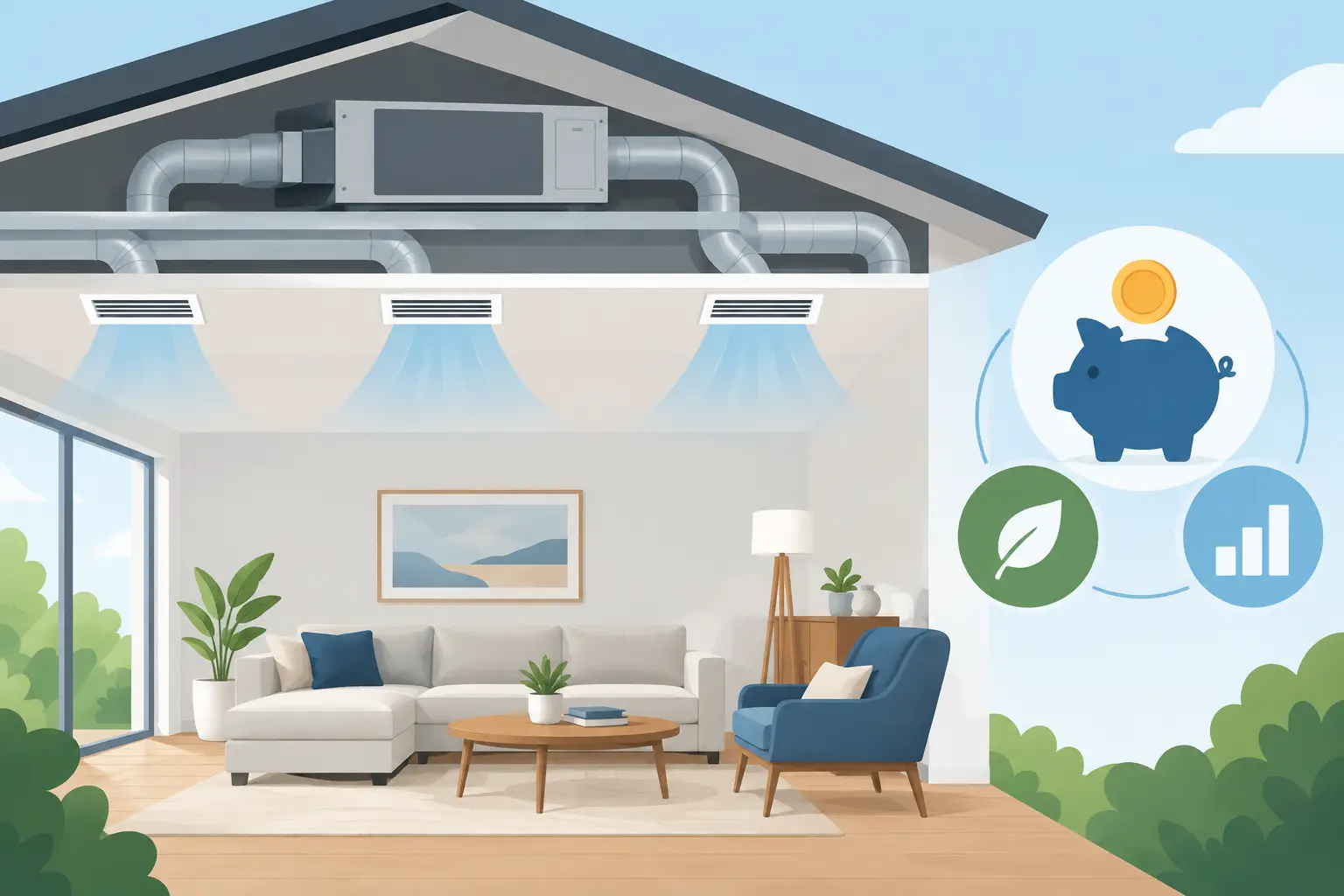
A whole-home ducted system can make a house feel consistently comfortable, but homeowners rightly want to know what that comfort will add to the utility bill. Ducted system running costs are not one fixed number. They depend on the equipment’s efficiency, the size and condition of the home, local electricity prices, outdoor temperatures, and, most of all, how the system is controlled.
For many households, a properly sized ducted heat pump with zoning is a practical way to cool or heat several rooms without running separate units throughout the home. The key is to look beyond the purchase price and understand the daily choices that shape long-term operating costs.
What determines ducted system running costs?
A ducted air conditioning system uses an outdoor unit, an indoor fan coil, and concealed ductwork to distribute conditioned air through ceiling or floor vents. Because it can serve much of a home, its electricity use may be higher than a single-room mini-split at any one moment. That does not automatically make it more expensive to operate. Cooling or heating multiple occupied rooms with one well-designed system can be more efficient and more convenient than running several individual units.
The system’s capacity is the starting point. A unit that is too small may run continuously on hot or cold days and still struggle to maintain the set temperature. An oversized unit can cycle on and off too quickly, which wastes energy, reduces humidity control in cooling mode, and adds wear. Correct load calculations account for the home’s square footage, insulation, window size and orientation, ceiling height, occupancy, and local climate.
Equipment efficiency matters as well. Higher SEER2 and HSPF2 ratings generally indicate lower electricity consumption for equivalent cooling and heating output. Variable-speed inverter systems are especially useful because they can reduce output once the home is close to the selected temperature instead of repeatedly running at full capacity. They often cost more upfront, but the lower energy use and steadier comfort can justify that difference for homes using central air regularly.
Your electricity rate has an equally direct effect. A system that uses 4 kilowatts while operating for three hours consumes roughly 12 kilowatt-hours. At $0.25 per kilowatt-hour, that is about $3 for that period. Actual use will vary because an inverter system does not draw the same amount of power every minute, and a mild day requires far less work than an extreme one.
Estimating the cost to run a ducted system
The simplest calculation is:
Power draw in kW × hours of use × electricity rate per kWh = estimated operating cost
For example, assume a ducted heat pump averages 3.5 kW during a summer afternoon and operates for five hours. At an electricity rate of $0.22 per kWh, the estimated cost is $3.85 for that day. If it runs at that average level for 20 days in a month, the cooling portion of the bill would be around $77.
This is only an estimate, not a promise. The system may draw more power when first bringing a hot home down to temperature, then less once it settles. A home with strong attic insulation, shaded windows, and sealed gaps will need less cooling than a similar-sized home with sun-exposed glass and air leaks. In heating mode, performance also changes with outdoor conditions. Heat pumps remain an efficient choice in many climates, but their output and efficiency can reduce in very low temperatures.
It is also worth distinguishing energy use from total ownership cost. Electricity is the ongoing expense homeowners notice most, but filter changes, professional maintenance, occasional repairs, and eventual replacement should be part of the bigger budget. Good installation and regular service help protect both efficiency and equipment life.
Why zones can make a meaningful difference
Zoning divides a ducted system into separate areas, such as living spaces, bedrooms, an upstairs level, or a home office. Motorized dampers and thermostats direct conditioned air where it is needed, rather than conditioning every room at the same time.
A family may cool the kitchen and living area in the afternoon, then switch to bedroom zones later in the evening. A remote worker may only need a home office zone during the day. This flexibility can reduce energy use, particularly in larger homes with rooms that sit empty for long periods.
Zoning is not a substitute for proper system design. Closing too many zones on a system that was not designed for that operating condition can restrict airflow and create noise, pressure, or performance problems. A qualified contractor should match the equipment, duct layout, return-air design, and zoning controls so the system can operate safely across expected combinations of open zones.
The hidden factors that raise utility bills
Ductwork is often out of sight, which makes it easy to overlook. Leaky, crushed, undersized, or poorly insulated ducts can lose conditioned air before it reaches the rooms where it is needed. Long duct runs through a hot attic can also add heat back into cooled air. The result is longer run times, uneven temperatures, and higher bills.
Return-air pathways deserve the same attention. A ducted system cannot deliver the right amount of supply air if it cannot pull enough air back to the indoor unit. Restricted returns, dirty filters, or blocked vents place strain on the fan and can make rooms feel stuffy even when the thermostat is set correctly.
Thermostat habits have a major impact too. Setting cooling to 68°F during a heat wave will cost more than maintaining a moderate 75°F to 78°F, and setting heating very high in winter has the same effect. A programmable or smart thermostat can make this easier by adjusting temperatures around work, school, and sleep schedules. The goal is not to turn the system off whenever you leave for a short time, since reheating or recooling a heavily heat-soaked home can require a large burst of energy. Instead, use a modest setback and return to the comfort setting before the home is occupied.
Ways to reduce ducted heating and cooling costs
The most effective savings usually come from a combination of sensible settings, maintenance, and building improvements. Start by keeping filters clean. A dirty filter restricts airflow, increases fan energy use, and may contribute to coil problems. Check it monthly during heavy use and replace or clean it according to the system manufacturer’s instructions.
Keep supply vents and return grilles clear of furniture, rugs, and curtains. Closing vents in unused rooms is not always beneficial on a central system, especially without designed zoning. It can increase duct pressure and reduce airflow where it is needed. Use your installed zones and thermostat controls rather than trying to force savings by blocking vents.
Improve the home’s thermal envelope where practical. Weatherstripping doors, sealing obvious gaps, adding attic insulation, using window coverings on sunny exposures, and addressing poorly performing windows all reduce the load on the HVAC system. These measures also improve comfort when the air conditioner is not running.
Professional maintenance should include more than a quick visual check. A technician can inspect electrical components, refrigerant performance, condensate drainage, airflow, coils, duct condition, and control operation. Small issues such as a weak capacitor, a dirty outdoor coil, or an airflow restriction can gradually increase operating costs before they become a breakdown.
When a higher bill signals a problem
A seasonal increase is expected during unusually hot or cold weather. A sudden, unexplained jump in energy use deserves attention, especially if it comes with weak airflow, hot and cold spots, longer run times, new noises, water leaks, or ice around equipment.
The cause may be as simple as a clogged filter or a thermostat schedule that changed after a power outage. It may also point to duct leakage, a failing component, refrigerant issues, or equipment that is no longer performing efficiently. Waiting until the system stops completely can turn a manageable repair into a more disruptive and costly situation.
For homeowners planning a replacement, the lowest-priced system is not always the lowest-cost option over its life. An accurate load calculation, thoughtfully designed ducts, useful zoning, and a system matched to the property usually have a greater effect on comfort and running costs than a headline efficiency rating alone. Cool Air Tech can assess those details and provide straightforward advice based on how the property is actually used.
The best next step is to review a few real utility bills alongside your thermostat habits and the condition of the system. That gives you a clearer starting point than a generic cost estimate, and it helps identify whether a simple adjustment, maintenance visit, or larger upgrade will deliver the most value.