
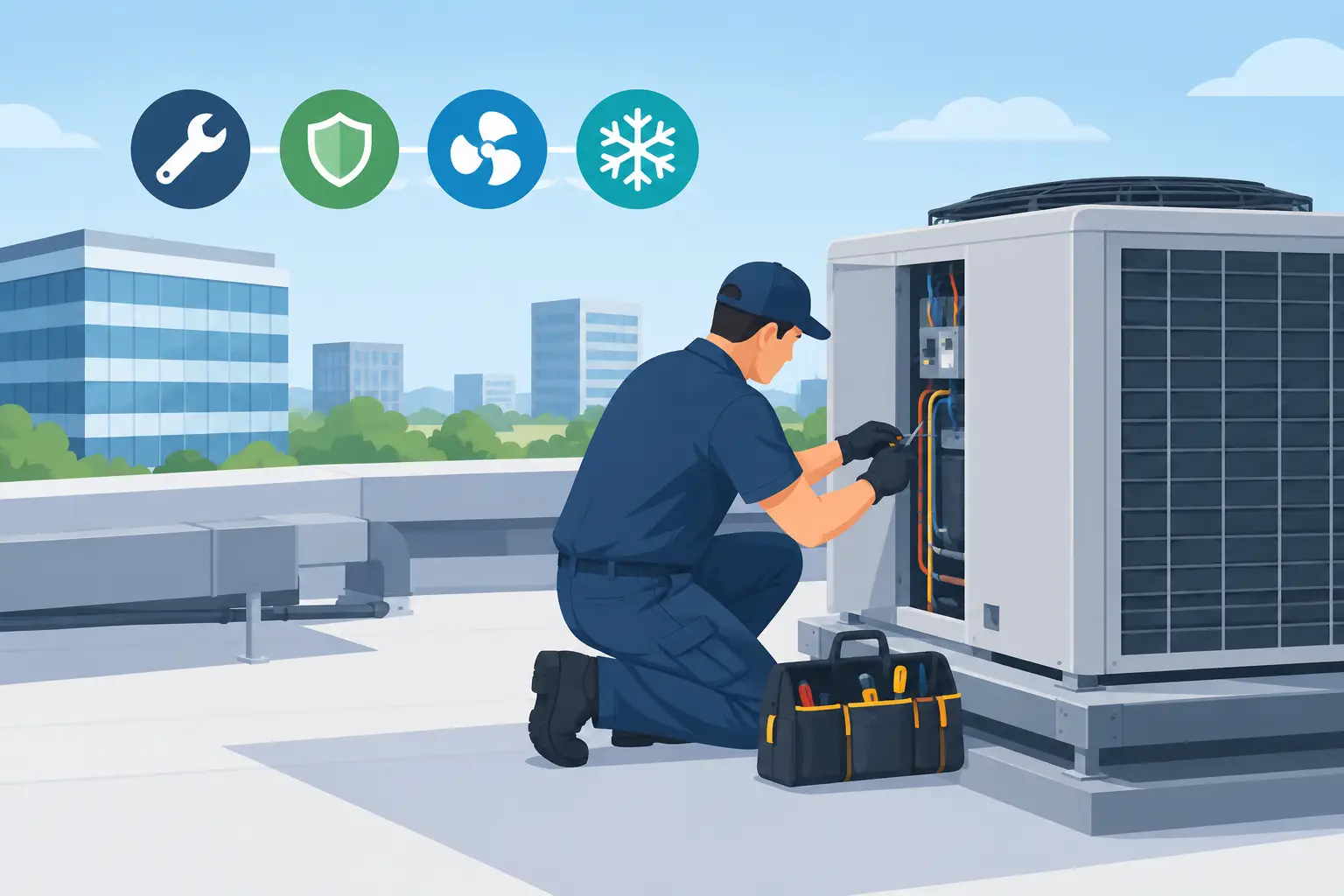
A packed office that turns stuffy by 10 a.m., a retail floor with uneven temperatures, or a server room running hot can quickly become a business problem. This commercial HVAC maintenance guide explains how planned service helps protect comfort, equipment life, energy use, and day-to-day operations before a small fault becomes an expensive emergency callout.
Commercial heating, ventilation, and air conditioning systems work harder than most people realize. They often run long hours, serve areas with changing occupancy, and must manage heat from people, lighting, equipment, and direct sunlight. Whether your property uses split systems, ducted equipment, multi-split units, or a VRF/VRV system, maintenance should reflect how the building is actually used.
Why commercial HVAC maintenance is worth planning
Waiting for an air conditioning system to fail is rarely the lower-cost option. A worn fan belt, blocked drain, dirty coil, loose electrical connection, or low refrigerant charge can begin as a modest repair. Left unchecked, it can cause poor performance, higher power bills, water damage, compressor stress, or a full shutdown during peak demand.
For business owners and property managers, the cost of a breakdown is not limited to the repair invoice. Staff productivity can suffer in an uncomfortable office. Customers may leave a shop that feels too hot or too cold. Temperature-sensitive stock, IT equipment, and tenant relationships can also be affected. Preventive maintenance gives you more control over timing, budgeting, and disruption.
It also supports efficiency. When filters, coils, fans, and controls are clean and operating correctly, the system does not need to work as hard to reach the set temperature. Savings vary by system condition, run time, and building design, but neglected equipment almost always uses more energy than well-maintained equipment.
What a commercial HVAC maintenance visit should cover
A proper visit is more than replacing a filter and confirming that cool air is coming out of a grille. The technician should assess the equipment, its controls, and the conditions affecting performance. The exact scope depends on the system type, age, warranty requirements, and site risks, but a thorough service commonly includes the following work:
- Inspecting and cleaning or replacing air filters, then checking airflow across indoor units and return-air paths.
- Checking indoor and outdoor coils, fan motors, belts, bearings, electrical connections, capacitors, contactors, and safety controls.
- Clearing condensate drains and checking drain pans, pumps, and pipework for blockages or leaks.
- Testing operating temperatures, refrigerant performance, thermostat accuracy, zoning controls, and overall system response.
The technician should also look for signs that point to a developing problem: unusual noise, vibration, ice buildup, damaged insulation, corrosion, recurring drainage issues, or rooms that consistently miss their temperature setpoint. Good maintenance produces useful observations, not just a completed checklist.
Filters, coils, and airflow
Airflow is central to cooling and heating performance. A clogged filter restricts air entering the unit, while dust and debris on evaporator or condenser coils reduce heat transfer. The result can be weak airflow, uneven temperatures, longer run times, and unnecessary strain on key components.
Filter replacement intervals are not one-size-fits-all. A low-traffic office may need less frequent changes than a restaurant, warehouse, medical practice, pet-friendly business, or street-facing retail store. Construction nearby can also load filters far faster than expected. Rather than following a calendar blindly, review filter condition and adjust the schedule to suit the site.
Drainage and moisture control
In cooling mode, indoor units remove moisture from the air. That water must drain away reliably. Blocked drain lines and failed condensate pumps are among the most preventable causes of indoor water leaks.
A drain issue can damage ceilings, walls, stock, and electrical equipment, particularly where concealed ducted units sit above finished spaces. Regularly clearing drains and inspecting pans is simple preventive work with a high payoff.
Electrical and control checks
Commercial systems rely on electrical components and controls to start, regulate output, and protect equipment. Loose wiring, worn contactors, failing capacitors, and control faults may not stop a system immediately, but they can create intermittent operation that is difficult for staff to diagnose.
Modern multi-zone and VRF/VRV systems add another layer of control. A maintenance visit should confirm that controllers, sensors, communication wiring, schedules, and zoning functions are working as intended. A system can be mechanically sound yet waste energy because a zone is scheduled incorrectly or a sensor is reading the wrong temperature.
How often should commercial HVAC equipment be serviced?
For many small and mid-sized commercial properties, twice-yearly planned maintenance is a sensible starting point: once before the cooling season and once before the heating season. This timing allows a technician to identify issues before the equipment reaches its busiest period.
Some sites need more frequent attention. Restaurants, gyms, medical facilities, high-occupancy offices, warehouses with dust exposure, and businesses that operate extended hours may benefit from quarterly service. Equipment that cools server rooms or other critical areas may need closer monitoring because downtime carries greater risk.
Older systems also deserve a tailored approach. More frequent inspections can help extend usable life, but there is a point where repeated repairs no longer represent good value. An experienced contractor should be candid about that trade-off, explaining whether a repair, targeted upgrade, or replacement is the most practical option.
A practical commercial HVAC maintenance guide for managers
A service contractor handles the technical work, but building managers and staff play an important role between visits. Give one person responsibility for reporting recurring concerns and keeping basic records. Notes about room temperatures, leak locations, error codes, unusual noises, and when problems occur can shorten diagnostic time significantly.
Keep outdoor units accessible and clear of leaves, packaging, stored materials, and other obstructions. Inside, avoid blocking return-air grilles with furniture, displays, or partitions. If a space is renovated, reconfigured, or fitted with heat-producing equipment, have the HVAC setup reviewed. The original system may no longer be serving the load it was designed for.
Set temperatures realistically and avoid constant changes to thermostats. Extreme settings do not cool or heat a space faster. They usually make the system run longer and can create complaints in adjacent zones. For businesses with set operating hours, use scheduling controls so the system is not conditioning empty areas unnecessarily.
Signs you should book service sooner
Do not wait for the next scheduled visit if you notice a clear change in performance. Warm air during cooling, weak airflow, frequent cycling, musty odors, water leaks, ice on pipework, tripped breakers, or new rattling sounds all justify a professional inspection.
Rising utility costs can be another warning sign, especially when business hours and weather patterns have remained similar. The cause may be HVAC-related, but it could also involve controls, building insulation, doors left open, or a new internal heat load. A careful assessment looks at the full picture rather than assuming one component is at fault.
Choosing a maintenance agreement that fits your property
The best maintenance agreement is not necessarily the one with the longest checklist. It is the one that matches your equipment, operating hours, occupancy, and business priorities. Ask what is included at each visit, how filter changes are handled, whether reports identify recommended repairs by urgency, and how emergency callouts are managed.
Transparent reporting matters. You should be able to see what was inspected, what was found, what requires attention now, and what can be planned for later. This makes budgeting easier and avoids surprise recommendations after a failure.
For multi-tenant or larger sites, it can also help to maintain an equipment register with unit locations, model details, installation dates, service history, and known issues. That information supports faster service and more informed replacement planning when equipment approaches the end of its useful life.
A well-maintained HVAC system should fade into the background of your business, keeping employees, customers, and equipment comfortable without demanding constant attention. Start with a schedule that suits your property, act early on warning signs, and treat service records as a tool for making smarter decisions about the next repair or upgrade.