
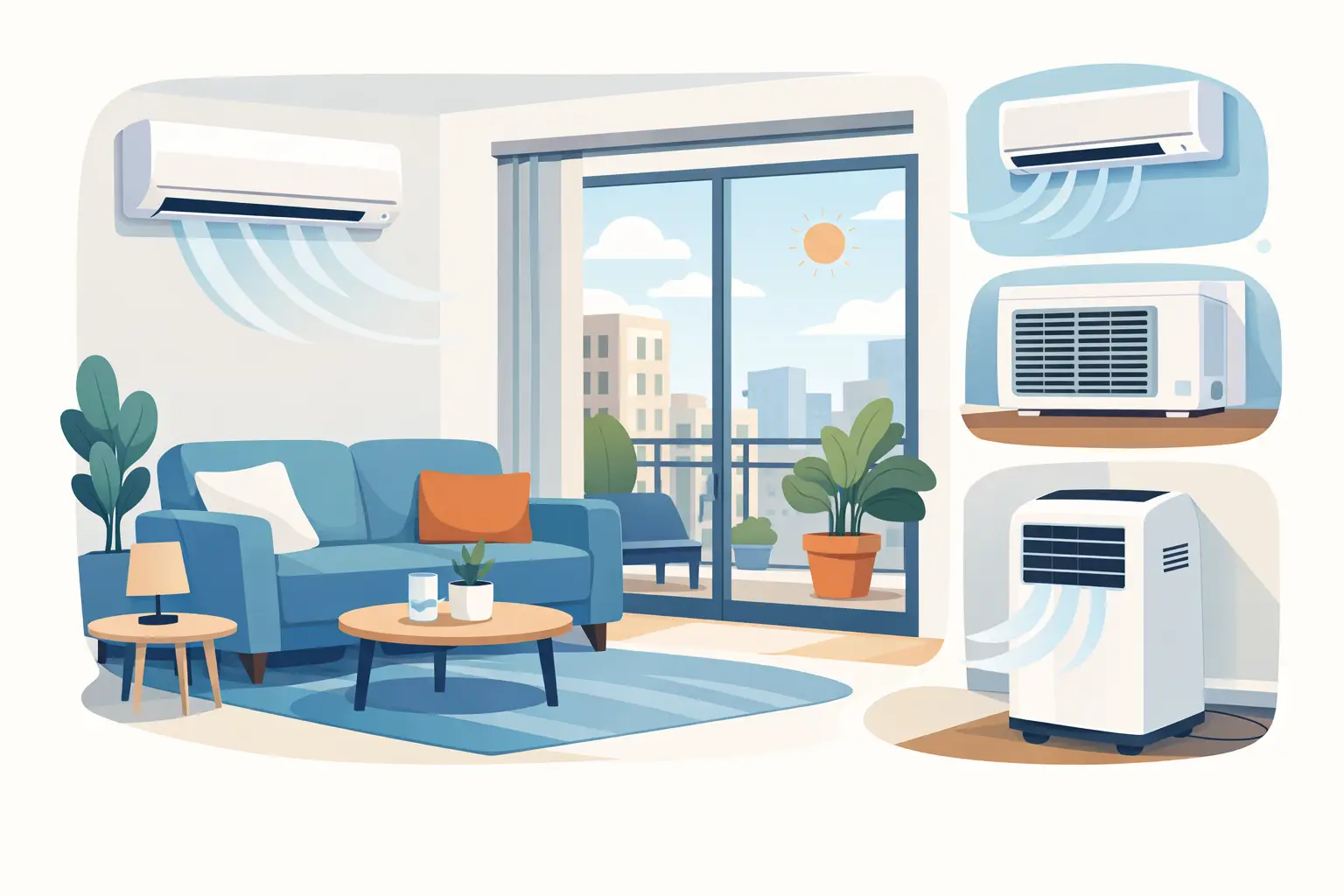
Apartment cooling is rarely as simple as choosing the biggest unit that fits the room. The best air conditioning for apartment living must cool effectively without creating noise complaints, overloading electrical circuits, blocking windows, or breaching building rules.
For most apartment owners, a properly sized ductless split system offers the best balance of comfort, efficiency, and quiet operation. However, renters, heritage buildings, high-rise properties, and apartments with strict strata or HOA requirements may need a different approach. The right answer depends on your floor plan, ownership status, building approvals, and how many rooms you need to cool.
What Makes the Best Air Conditioning for an Apartment?
An apartment air conditioning system should do more than lower the temperature. It should suit limited space, operate quietly, and provide manageable running costs. In a compact home, an oversized system can cool the room too quickly, switch on and off repeatedly, and leave the air feeling humid. An undersized system will run constantly on hot days without delivering the comfort you expect.
The best option also needs to work within the building itself. Outdoor equipment may require approval, condensate drainage must be handled correctly, and the available electrical supply may limit what can be installed. These details are often where a professional site inspection makes the difference between a system that looks good on paper and one that works well for years.
Start with the rooms you actually use
A single open-plan living area has very different requirements from a two-bedroom apartment with closed doors, afternoon sun, and floor-to-ceiling glass. Think about where heat builds up first, whether bedrooms need overnight cooling, and how often each space is occupied.
If you mainly need relief in the living room during the day, one wall-mounted unit may be enough. If each bedroom needs individual temperature control, a multi-zone solution may be worth the higher upfront investment.
Ductless Split Systems: The Best All-Around Choice
A ductless split system has an indoor wall-mounted unit and an outdoor condenser connected by refrigerant pipework. It is usually the strongest long-term choice for an owner-occupied apartment, provided the building allows an outdoor unit.
Modern split systems are quiet, efficient, and capable of both cooling and heating. Inverter technology allows the compressor to adjust its output rather than simply cycling on and off, which improves comfort and can reduce energy use. Many models also include timers, Wi-Fi control, air filtration features, and sleep settings for bedroom use.
Installation quality matters as much as the equipment. The indoor unit must be positioned for clear airflow, the outdoor unit needs adequate ventilation and service access, and condensate water must drain safely. Poor placement can lead to uneven temperatures, water leaks, excessive noise, or reduced performance.
A single split system is often ideal for a studio, one-bedroom apartment, or open-plan living space. It may not be enough for a larger apartment with multiple enclosed rooms. Cool air does not reliably travel through hallways and around closed doors, especially during extreme heat.
Multi-Split Air Conditioning for Multiple Rooms
A multi-split system connects several indoor units to one outdoor condenser. This can be an effective option when exterior space is limited but you want separate units in the living room and bedrooms.
The main advantage is room-by-room control. One person can cool a bedroom at night while another uses the living area, without conditioning the entire apartment unnecessarily. This can improve comfort and avoid wasting energy on unoccupied rooms.
There are trade-offs. Multi-split systems cost more to install than a single split system, and their design needs careful planning. Pipe routes, outdoor-unit capacity, electrical requirements, and the location of each indoor unit all affect the final result. For apartments with three or more zones, the system should be designed around realistic usage rather than simply adding a unit to every room.
Window Units and Portable Air Conditioners
Window air conditioners can offer affordable cooling where they are permitted. They are generally less expensive than permanent systems and can suit a renter who needs a straightforward solution for one room. However, many apartment buildings restrict window-mounted equipment because of appearance, safety concerns, water drainage, or façade rules.
Portable air conditioners are easier to move and typically require only a window kit for the exhaust hose. They can be useful for temporary cooling, short leases, or spaces where no permanent installation is allowed. Their limitations are significant: they take up floor space, create more indoor noise than split systems, and are usually less efficient.
A portable unit may be the practical choice if you rent and need a quick solution. It is rarely the best choice for long-term comfort in a hot apartment. The exhaust hose can also be awkward in sliding windows, and poorly sealed window kits allow warm air back into the room.
Is Ducted Air Conditioning Practical in an Apartment?
Ducted air conditioning provides a clean, built-in appearance and can deliver conditioned air across several rooms through discreet ceiling vents. Where it is feasible, it is an excellent solution for larger luxury apartments, penthouses, and major renovations.
The challenge is space. Ducted systems need room above ceilings for ductwork, indoor equipment, drain lines, and return-air pathways. Many existing apartments do not have enough ceiling cavity space, and structural elements can make alterations difficult. Installation may also require more extensive building approval than a wall-mounted split system.
If your apartment already has ductwork or was designed for central air, upgrading an older system can be worthwhile. If not, a multi-split system often provides similar zoning benefits with less disruption and a lower installation cost.
Check Building Rules Before Choosing a System
For apartment owners, approval should come before purchasing equipment. Condominiums, co-ops, and managed buildings may have rules about outdoor condensers, balcony placement, wall penetrations, operating noise, drainage, and approved contractors.
Ask for the building’s HVAC alteration requirements. Some properties specify where an outdoor unit can be installed, require acoustic treatment, or prohibit equipment visible from common areas. Others may require permits, engineering documentation, insurance certificates, or approval from a board or property manager.
Renters should get written permission from the landlord before installing any fixed system. Even a small wall penetration, electrical connection, or condenser mounted on a balcony can become a costly issue if it is not approved first.
Size, Efficiency, and Electrical Capacity Matter
Cooling capacity is commonly measured in BTUs. While room size is a starting point, correct sizing also depends on ceiling height, insulation, window size, sun exposure, local climate, and the heat produced by occupants and appliances.
Apartments with west-facing glass, top-floor exposure, or poor insulation often need more cooling capacity than their square footage suggests. Conversely, choosing a much larger system than necessary can reduce humidity control and increase equipment wear.
Look for energy-efficient equipment with a high SEER2 rating where available. Efficiency affects long-term operating cost, but it should not be the only consideration. A highly rated unit installed in the wrong location or paired with poor drainage and airflow will not perform as intended.
Electrical capacity should also be checked early. Some systems need a dedicated circuit, and older apartment buildings may have limited panel capacity. Addressing this before installation helps avoid delays and unexpected upgrade costs.
Don’t Overlook Noise and Drainage
Noise is a major consideration in close-quarter living. Indoor units should be selected and positioned with bedrooms, neighboring walls, and seating areas in mind. Outdoor condensers need vibration control and sufficient clearance so they do not transfer sound through balcony slabs or shared structures.
Condensate drainage deserves the same attention. Air conditioners remove moisture from the air, and that water must drain to an approved location. Letting condensate drip onto a balcony, sidewalk, or neighboring property can lead to complaints and damage. In some layouts, a condensate pump may be needed, but it should be installed where it can be serviced easily.
A Practical Way to Choose Your System
For a renter cooling one room, a portable or approved window unit may be the most realistic option. For an owner of a studio or one-bedroom apartment, a single ductless split system is usually the best value. For larger apartments with separate bedrooms, a multi-split system provides better comfort and control. Ducted air conditioning is best reserved for properties with enough ceiling space, suitable building access, and a renovation budget that supports it.
Before making a decision, arrange a professional assessment that considers your apartment layout, insulation, sunlight, building requirements, and electrical setup. The right system should fit the property as well as the people living in it. A well-designed installation gives you quiet, reliable comfort without turning your apartment into a construction compromise.